Nilotinib (AMN-107) inhibits c-Kit signaling to suppress synovial inflammation in peripheral spondyloarthritis
Copy code to add this image to your page
Spondyloarthritis (SpA) encompasses a spectrum of chronic inflammatory joint diseases characterized by axial and peripheral musculoskeletal manifestations. Pathologically, peripheral spondyloarthritis (pSpA) features marked synovial inflammation driven by infiltrating immune cell subsets, including macrophages and subepithelial mast cells. The receptor tyrosine kinase c-Kit (CD117) plays a critical regulatory role in mast cell lineage survival, differentiation, and effector functions. In pSpA target tissues, local activation of c-Kit sustains resident mast cell populations, triggering local degranulation and upstream expression of key pro-inflammatory cytokines such as interleukin-6 (IL-6) and interleukin-23 (IL-23). Consequently, target engagement of c-Kit represents a rational therapeutic strategy for disrupting local inflammatory loops in joint tissue.
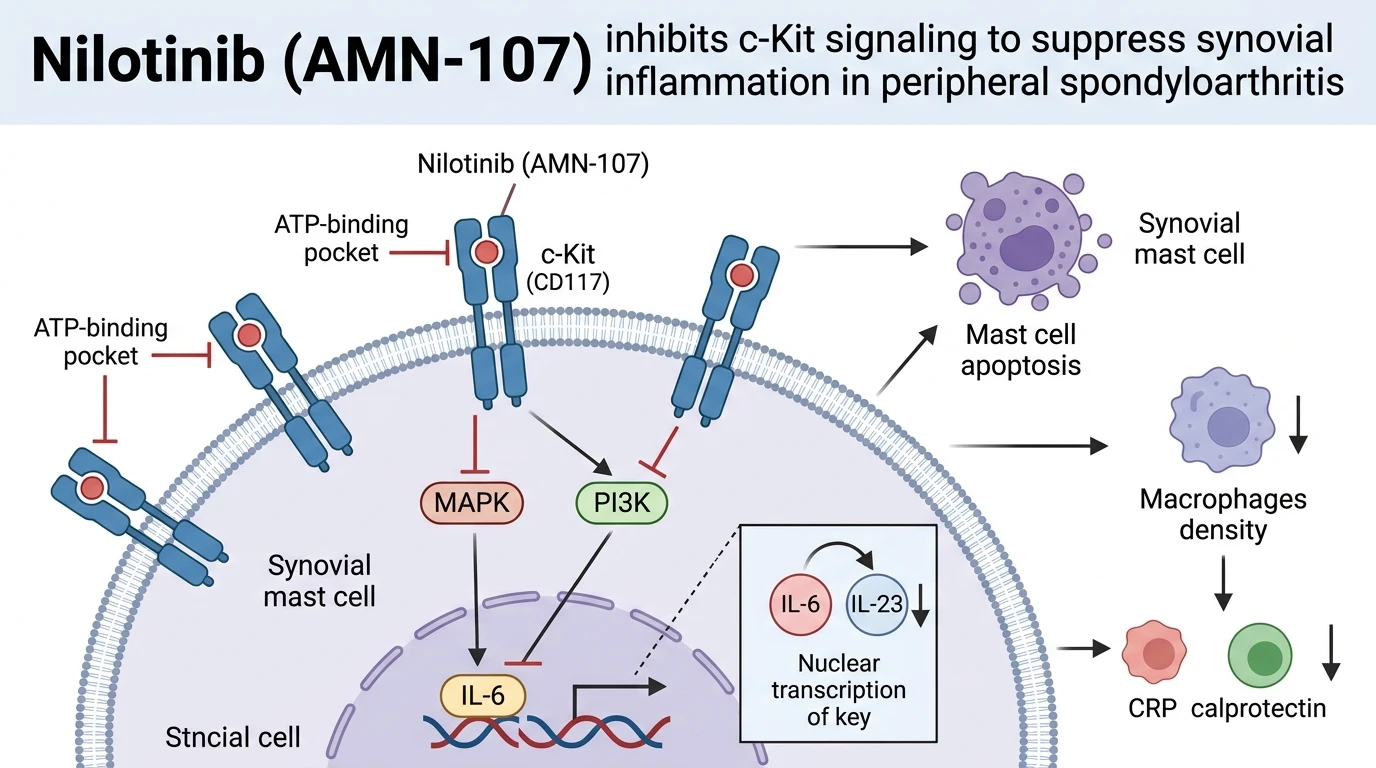
Evaluation of the potent second-generation tyrosine kinase inhibitor Nilotinib (AMN-107) in a randomized controlled proof-of-concept trial demonstrated distinct therapeutic utility depending on disease anatomical subtype. In patients presenting with active pSpA, small-molecule administration of AMN-107 yielded systemic and histopathological anti-inflammatory responses. Serial synovial biopsy analyses revealed a marked reduction in CD117-positive mast cells and CD68-positive macrophage density after target engagement. Concurrently, real-time quantitative PCR confirmed significantly decreased tissue mRNA levels of c-Kit, IL-6, and IL-23 relative to baseline values.
These local tissue-level alterations translated into systemic biomarker suppression and tangible clinical improvements. Circulating inflammatory markers—specifically C-reactive protein (CRP) and serum calprotectin (S100A8/S100A9)—showed sustained declines throughout the 12-to-24-week evaluation period. Disease activity scores, including the Ankylosing Spondylitis Disease Activity Score (ASDAS), decreased significantly in pSpA cohorts, corresponding with improved patient global assessment ratings.
Intriguingly, the therapeutic response to AMN-107 exhibited strict anatomical compartmentalization. In contrast to the robust efficacy observed in peripheral joint involvement, parallel cohorts with pure axial spondyloarthritis (axSpA) showed no statistically significant improvements in clinical disease activity scores, MRI-detected spinal inflammation, or systemic inflammatory biomarkers. This profound divergence indicates that while c-Kit signaling and mast cell-driven inflammation constitute active pathogenic drivers in peripheral synovium, axial bone marrow and entheseal pathology rely on alternative, c-Kit-independent inflammatory cascades. These empirical findings validate c-Kit target inhibition as a viable line of intervention tailored specifically to pSpA phenotypes.
Synovial Pharmacodynamics and Tissue Specificity in Spondyloarthritis
Copy code to add this image to your page
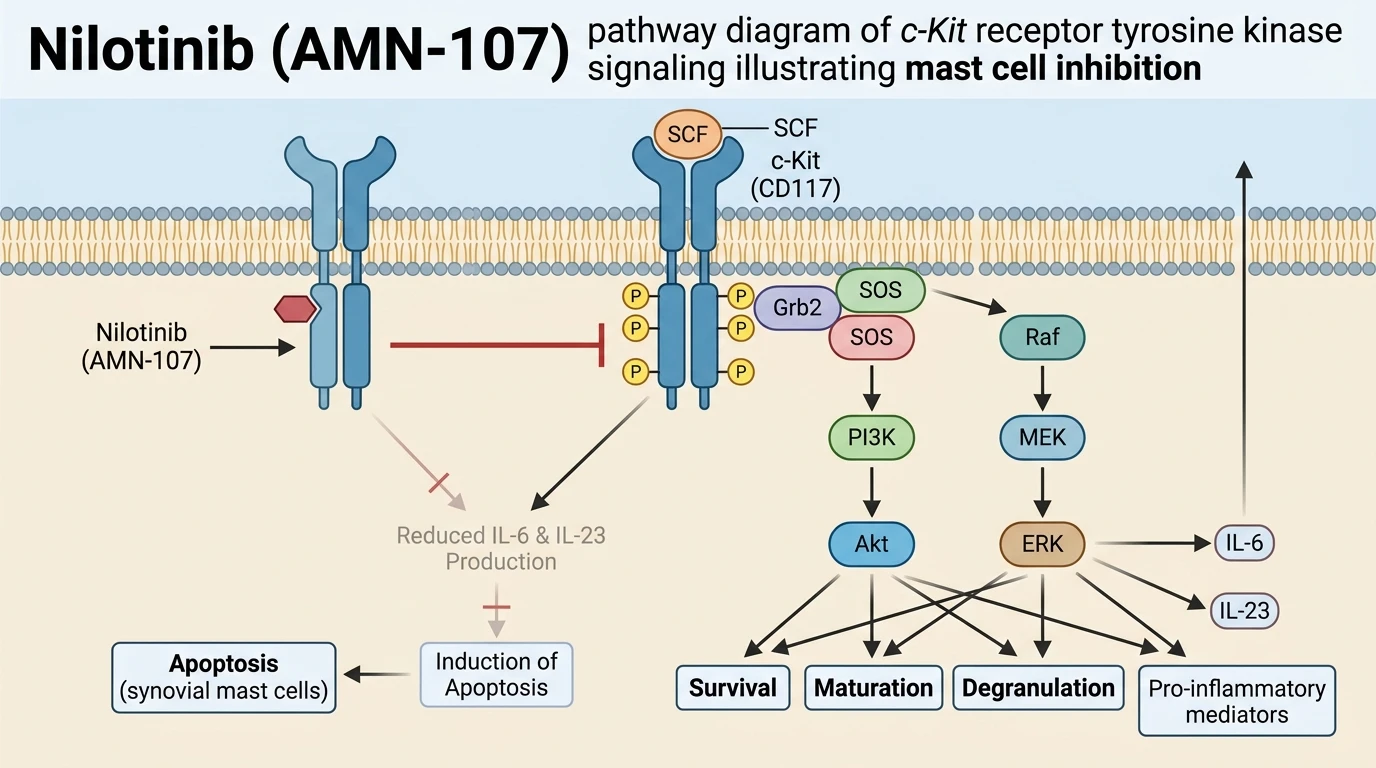
Nilotinib (AMN-107) acts as an ATP-competitive tyrosine kinase inhibitor of c-Kit (CD117) and c-Abl. By blocking c-Kit autophosphorylation in synovial mast cells, it downregulates downstream intracellular survival cascades, inducing mast cell apoptosis. This reduces local production of pro-inflammatory cytokines, specifically IL-6 and IL-23, and diminishes macrophage infiltration in peripheral joint tissue. The consequent reduction in tissue inflammation lowers systemic C-reactive protein and calprotectin, resulting in clinical disease suppression in peripheral spondyloarthritis.
Synovial Mast Cell Depletion and Cytokine Downregulation
Targeting c-Kit with AMN-107 directly altered local synovial biology in patients with peripheral disease. Pharmacodynamic analysis confirmed competitive inhibition of ATP binding within the c-Kit kinase domain. Downstream activation of survival pathways ceased within days of administration. Synovial mast cell density dropped significantly. Histological staining demonstrated a clear reduction in CD117-positive cell clusters across the sublining layer. Concurrently, mRNA transcript levels for IL-6 and IL-23 fell markedly in treated synovial biopsies. This local suppression disrupted paracrine signaling to infiltrating macrophages. Consequently, tissue macrophage numbers declined in parallel with diminished local cytokine output.
Divergent Clinical and Biomarker Responses in Axial Disease
Clinical outcomes revealed a precise biological boundary for tyrosine kinase inhibition in SpA phenotypes. In pSpA cohorts, ASDAS scores declined rapidly over 12 to 24 weeks. Systemic levels of C-reactive protein and serum calprotectin normalized in a majority of responders. However, patients with isolated axial spondyloarthritis showed minimal biomarker or clinical improvement. Spinal MRI scores remained unchanged throughout the trial duration. Biological differences in local tissue microenvironments explain this divergence. Axial lesions rely primarily on IL-17 signaling cascades independent of c-Kit activity. Thus, therapeutic c-Kit blockade remains highly effective in synovium but inactive in axial skeletal entheses.