FB23-2 FB232 FTO inhibitor cytotoxic off-target mechanisms in acute myeloid leukemia
Copy code to add this image to your page
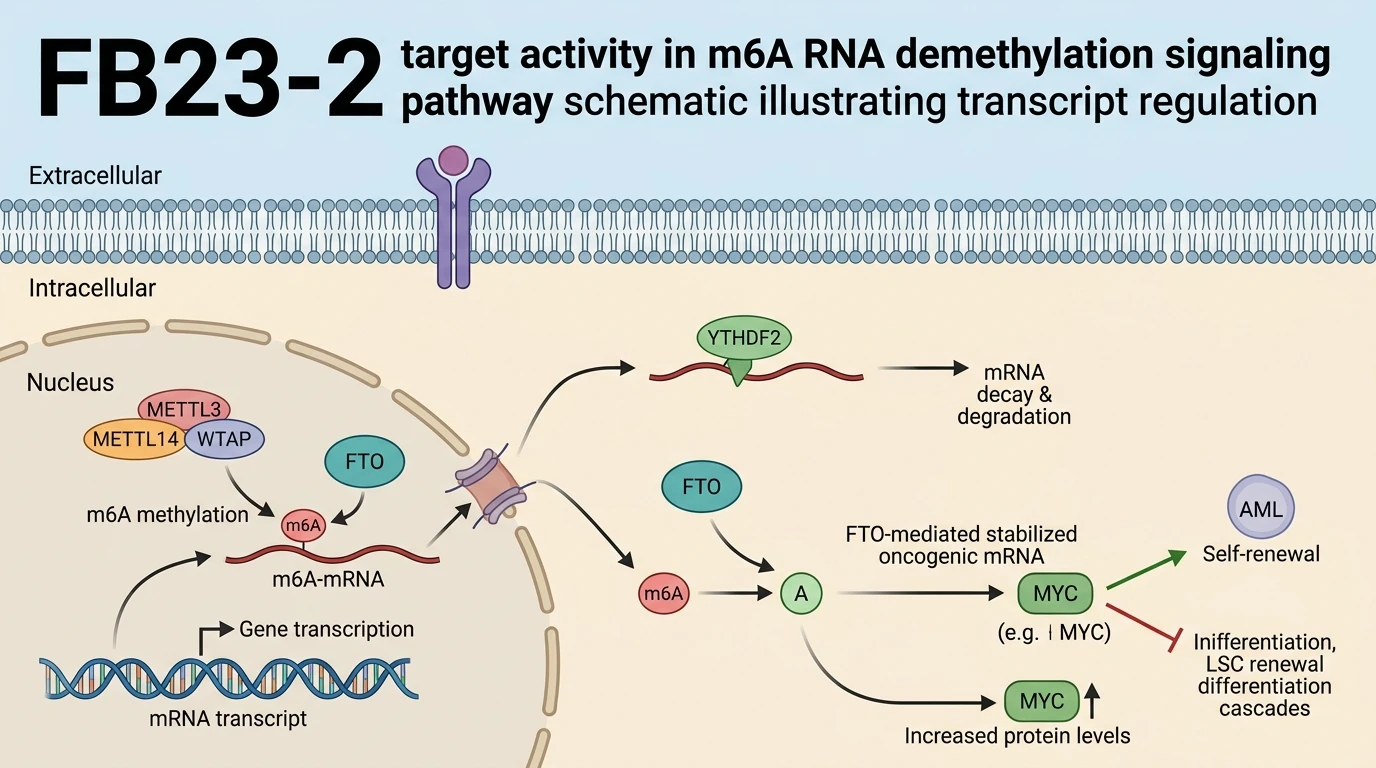
Small-molecule targeting of epitranscriptomic regulators has emerged as a major focus in chemical biology and experimental oncology. The RNA demethylase fat mass and obesity-associated protein (FTO) catalyzes the removal of N6-methyladenosine (m6A) modifications from target mRNAs, regulating transcript stability, splicing, and translation efficiency. Initial structural and biochemical characterization identified FB23-2 as a selective small-molecule inhibitor designed to engage the catalytic domain of FTO. Early assays indicated that application of this compound increased m6A stoichiometry on oncogenic transcripts, notably MYC, leading to transcript destabilization and subsequent cell death in acute myeloid leukemia (AML) models. Based on these observations, the agent gained broad traction as a probe compound for evaluating FTO biology in leukemogenesis.
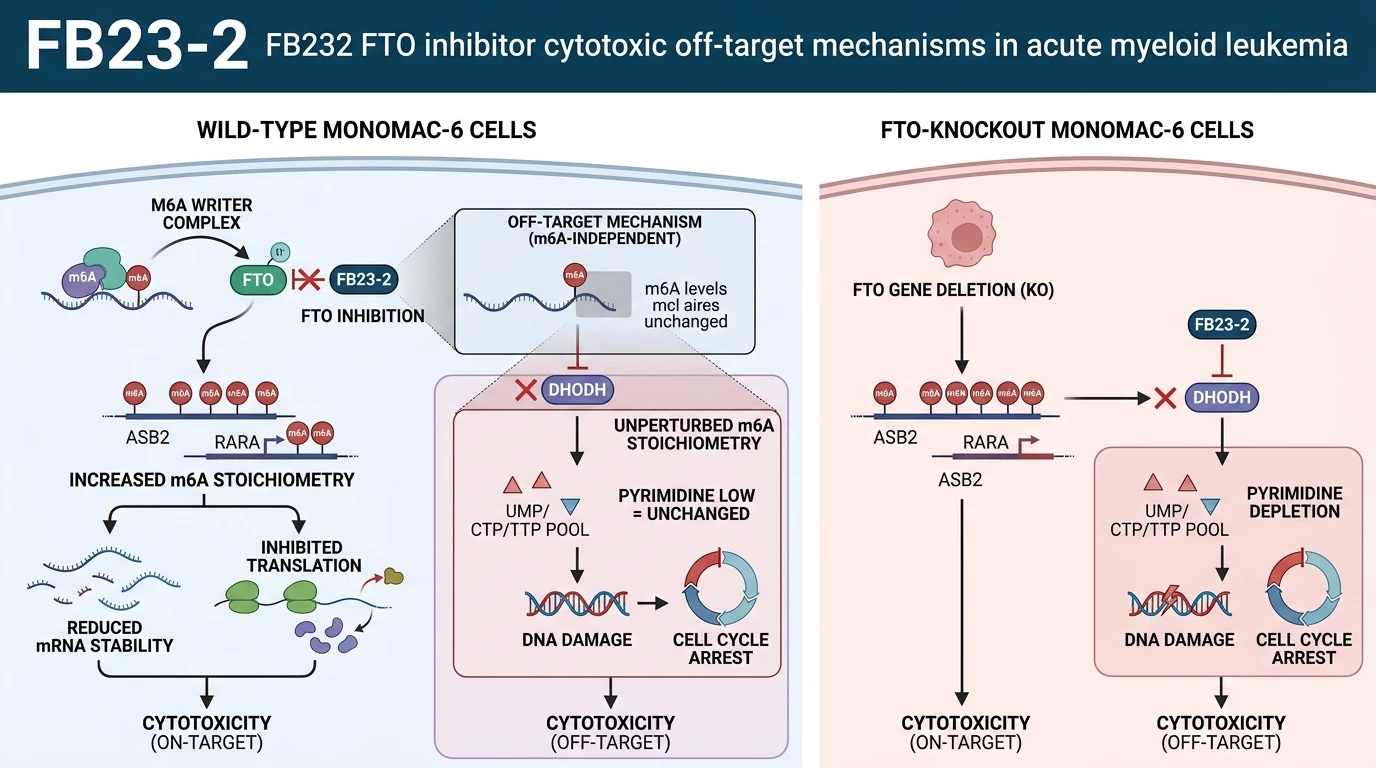
To rigorously test the proposed mechanism of action, direct single-molecule epitranscriptomic profiling was conducted using quantitative Oxford Nanopore direct RNA sequencing. Leukemic cell lines MONOMAC-6 and MOLM-13 were subjected to treatment with FB23-2 across multiple concentration thresholds and timepoints. Unexpectedly, direct RNA sequencing revealed no quantifiable shift in global m6A abundance following chemical exposure. Site-specific analysis of m6A modification fractions on MYC transcripts demonstrated identical modification frequencies between treated and vehicle control samples. The preservation of m6A marks under conditions that induce pronounced cellular lethality indicated that phenotypic responses decouple from FTO enzymatic inhibition within intact cellular environments.
Genetic validation experiments further clarified the target independence of FB23-2 in leukemic cells. Isogenic cell lines harboring CRISPR-Cas9-mediated FTO gene knockouts were established alongside wild-type controls. If anti-leukemic cytotoxicity were driven by FTO suppression, FTO-deficient cells would display intrinsic resistance or altered sensitivity to the drug. Comparative viability assays demonstrated nearly identical dose-response curves and half-maximal inhibitory concentrations (IC50) across both FTO-wild-type and FTO-knockout MONOMAC-6 lines. Cellular death proceeded with identical kinetics regardless of FTO protein expression. These genetic observations establish that the cytotoxicity exerted by the small molecule occurs independently of FTO status.
Subsequent biochemical profiling shifted toward identifying alternative molecular targets responsible for the observed cell death phenotype. Enzymatic screening panels revealed that FB23-2 engages dihydroorotate dehydrogenase (DHODH), an essential mitochondrial enzyme involved in the de novo pyrimidine biosynthesis pathway. Inhibition of DHODH depletes intracellular pyrimidine pools, triggering cell cycle arrest and apoptosis in rapidly dividing leukemic cells. Structural evaluations of catalytic domains, comparable to reference structures found in protein structural databases, highlight how small molecules can exhibit off-target affinity for nucleotide biosynthetic enzymes. The primary mechanism underlying FB23-2-induced lethality in AML models stems from metabolic disruption via DHODH off-target binding rather than epitranscriptomic reprogramming.
Pharmacological Re-evaluation and Off-Target Mechanisms of FB23-2
Copy code to add this image to your page
FB23-2 was characterized as an FTO inhibitor evaluating acute myeloid leukemia therapeutics. Direct RNA sequencing using Oxford Nanopore technology shows that FB23-2 exposure does not alter m6A stoichiometry globally or on MYC transcripts in MONOMAC-6 and MOLM-13 cells. Furthermore, FB23-2 displays equivalent cytotoxicity in FTO-wild-type and FTO-knockout cells. The cytotoxic impact of FB23-2 operates independently of FTO demethylase activity, resulting instead from off-target inhibition of dihydroorotate dehydrogenase (DHODH).
Direct Oxford Nanopore Sequencing Reveals Static m6A Stoichiometry
Quantitative direct RNA sequencing provided single-molecule resolution of m6A modifications across MONOMAC-6 and MOLM-13 transcripts. Compound administration failed to alter methyl-adduct frequency. Specifically, m6A stoichiometry at defined loci within MYC mRNA transcripts remained static relative to control samples. These empirical measurements contrast with earlier antibody-dependent enrichment assays. Epitranscriptomic marks were preserved despite escalating dosage regimens. Catalytic suppression of FTO does not drive transcriptomic shifts in these models.
FB23-2 Cytotoxicity Persists in FTO-Knockout Leukemic Models
Isogenic cell line pairs were established to evaluate target necessity. FTO-knockout MONOMAC-6 cells exhibited identical sensitivity when exposed to the FB232 FTO inhibitor relative to wild-type controls. Inhibitory concentration metrics shifted by less than two-fold between genetic groups. Cellular viability dropped rapidly regardless of target expression. This uniform loss of viability confirms that cytotoxicity proceeds through an FTO-independent pathway.
Off-Target DHODH Engagement Drives Cellular Lethality
Enzymatic profiling identified secondary binding interactions within nucleotide metabolic networks. Off-target inhibition of dihydroorotate dehydrogenase blocks pyrimidine synthesis at low micromolar concentrations. Exogenous uridine supplementation partially restores leukemic cell survival following compound administration. Mitochondrial bioenergetic stress accompanies this metabolic blockade. Anti-leukemic activity reflects pyrimidine depletion rather than m6A modification changes.