Z-VAD-FMK Inhibits Caspase-3 Processing to Block Rg3 Cytotoxicity in Breast Cancer
Copy code to add this image to your page
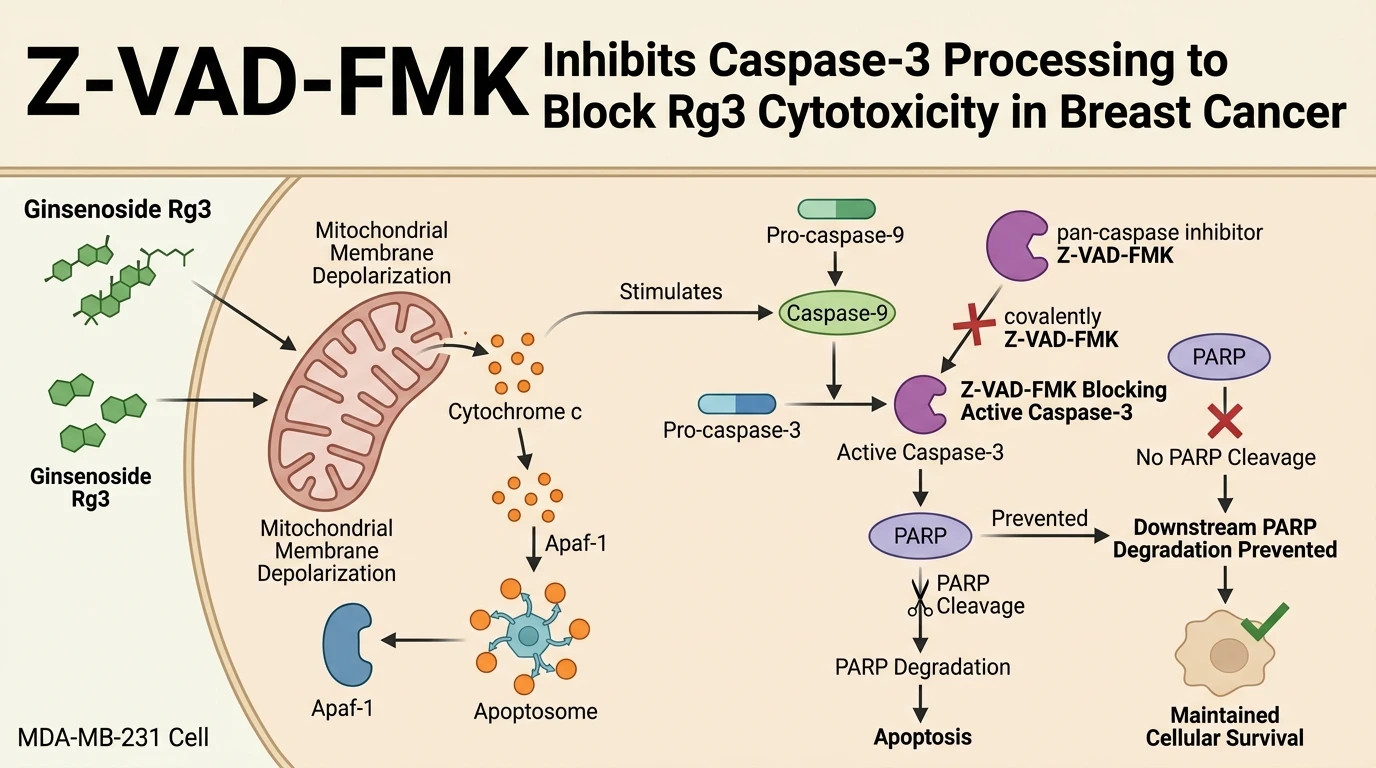
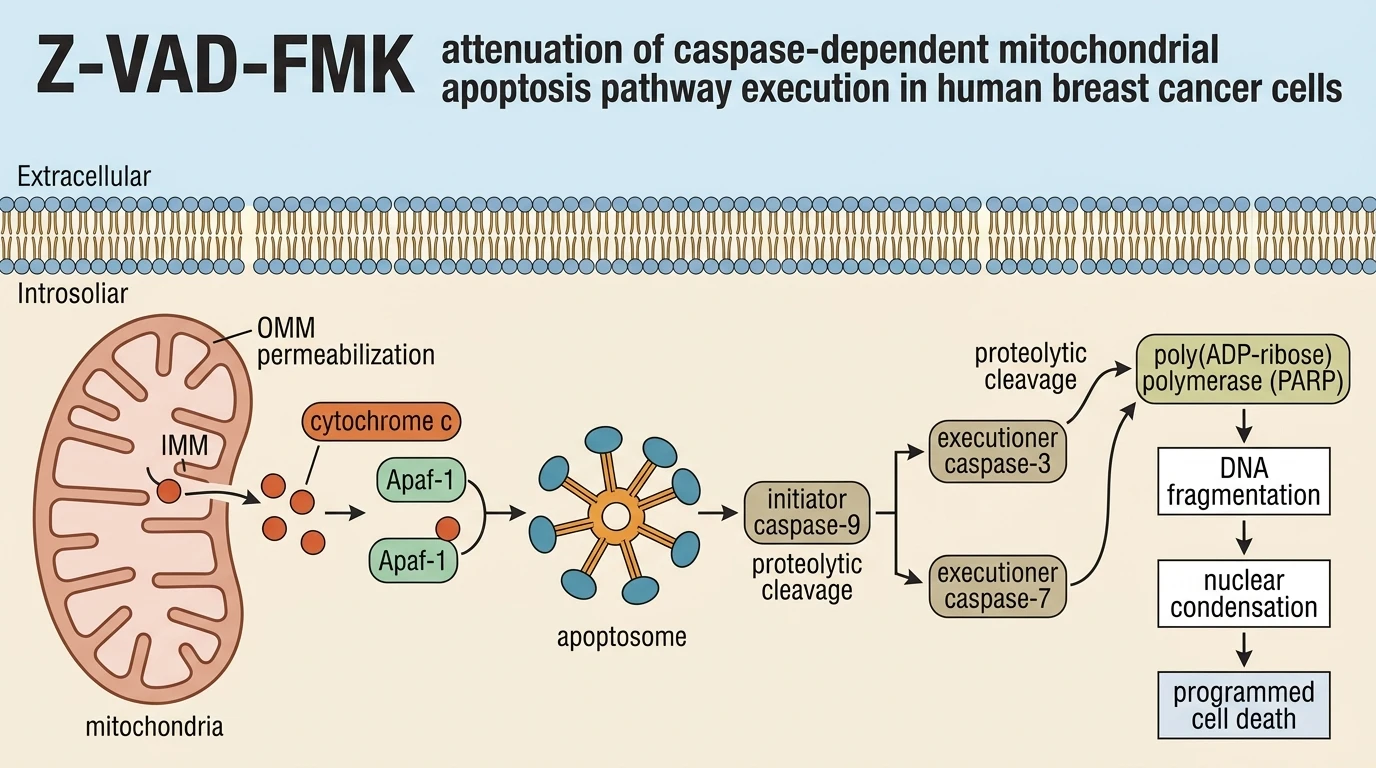
Programmed cell death pathways govern cellular turnover and response to pharmacological stressors. Among these cascades, the intrinsic mitochondrial apoptosis pathway acts as a key effector in drug-induced cytotoxicity. In human breast cancer (MDA-MB-231) cells, ginsenoside Rg3 triggers cell death by stimulating mitochondrial outer membrane permeabilization. This organellar stress leads to the activation of initiator and executioner cysteine-aspartic proteases. To clarify whether Rg3-induced cell lethality relies directly on catalytic protease function, researchers employ broad-spectrum kinetic inhibitors to uncouple upstream signaling events from terminal cellular degradation.
Cell-permeable peptide fluoromethyl ketones serve as powerful tools for probing enzyme-driven lethal cascades. As a synthetic tripeptide derivative, Z-VAD-FMK possesses a benzyloxycarbonyl N-terminal blocking group and an O-methylated aspartic acid residue terminating in a fluoromethyl ketone group. This chemical architechture enables passive diffusion across lipid membranes. Once inside the cytoplasm, the molecule acts as an irreversible suicide inhibitor across the caspase family. The compound binds the active site cysteine residue of target proteases, forming a covalent thioether adduct that permanently inactivates caspase-3 target inhibition mechanisms and prevents catalytic cleavage of peptide substrates.
Experimental evaluation in MDA-MB-231 triple-negative breast cancer cells demonstrated that treatment with ginsenoside Rg3 at a concentration of 30 µM induced robust cytotoxic responses. When cells were co-treated with 25 µM Z-VAD-FMK, this cytotoxic effect was completely abrogated. Western blot analysis confirmed that Rg3 exposure promoted the proteolytic conversion of the 32 kDa pro-caspase-3 zymogen into its active catalytic subunits. Furthermore, active caspase-3 subsequently targeted poly(ADP-ribose) polymerase (PARP), generating the characteristic 89 kDa cleavage fragment indicative of irreversible apoptotic commitment.
Co-incubation with 25 µM Z-VAD-FMK fully blocked the cleavage of both pro-caspase-3 and PARP. This suppression of substrate processing demonstrates that Rg3 cannot bypass caspase inhibition to execute cell death. The preservation of full-length PARP and cellular viability confirms that Rg3 operates via a strictly caspase-dependent mitochondrial apoptotic routine rather than alternative necrotic or autophagic death programs in this specific cellular context. These empirical data establish that executioner caspase activity is mandatory for Rg3-mediated anti-tumor activity in breast carcinoma models.
Pharmacological Evaluation of Protease Inhibition in Breast Carcinoma
Copy code to add this image to your page
Z-VAD-FMK functions as an irreversible pan-caspase inhibitor that covalently binds the active site cysteine of caspase-3. In human breast cancer (MDA-MB-231) cells, co-treatment with 25 µM Z-VAD-FMK abrogates 30 µM ginsenoside Rg3-induced cytotoxicity. This inhibition blocks the proteolytic cleavage of pro-caspase-3 and its downstream substrate PARP, thereby confirming that Rg3 induces cell death via a caspase-dependent mitochondrial apoptotic pathway.
Blockade of Proteolytic Caspase-3 Cleavage in MDA-MB-231 Cells
Ginsenoside Rg3 functions as an active pro-apoptotic agent in triple-negative breast cancer models. At an experimental concentration of 30 µM, Rg3 activates the intrinsic apoptotic pathway. This process triggers executioner proteases. However, pre-treatment with Z-VAD-FMK at 25 µM neutralizes this proteolytic cascade. Immunoblot assays showed an absence of active caspase-3 cleavage fragments. The zymogen remained unprocessed across evaluated time points. Downstream catalytic activity ceased completely within the cytosolic compartment. These observations demonstrate that Rg3 requires active caspase-3 to drive cellular dissolution under tested in vitro assay conditions.
Attenuation of PARP Processing Restores Viability Under Rg3 Stress
Executioner caspases digest structural and repair proteins during final apoptotic phases. Poly(ADP-ribose) polymerase serves as a primary substrate for caspase-3 cleavage. Co-treatment with Z-VAD-FMK completely prevented the formation of the 89 kDa PARP fragment. Cellular survival assays demonstrated full recovery from Rg3 cytotoxicity. Viability metrics matched untreated control groups. Membrane integrity remained fully preserved. These empirical findings indicate that blocking terminal substrate cleavage preserves cell survival under acute natural product challenge within this carcinoma line.