DSS Crosslinker Assays Reveal ASC Polymerization in NLRP3 Inflammasome Signaling
Copy code to add this image to your page
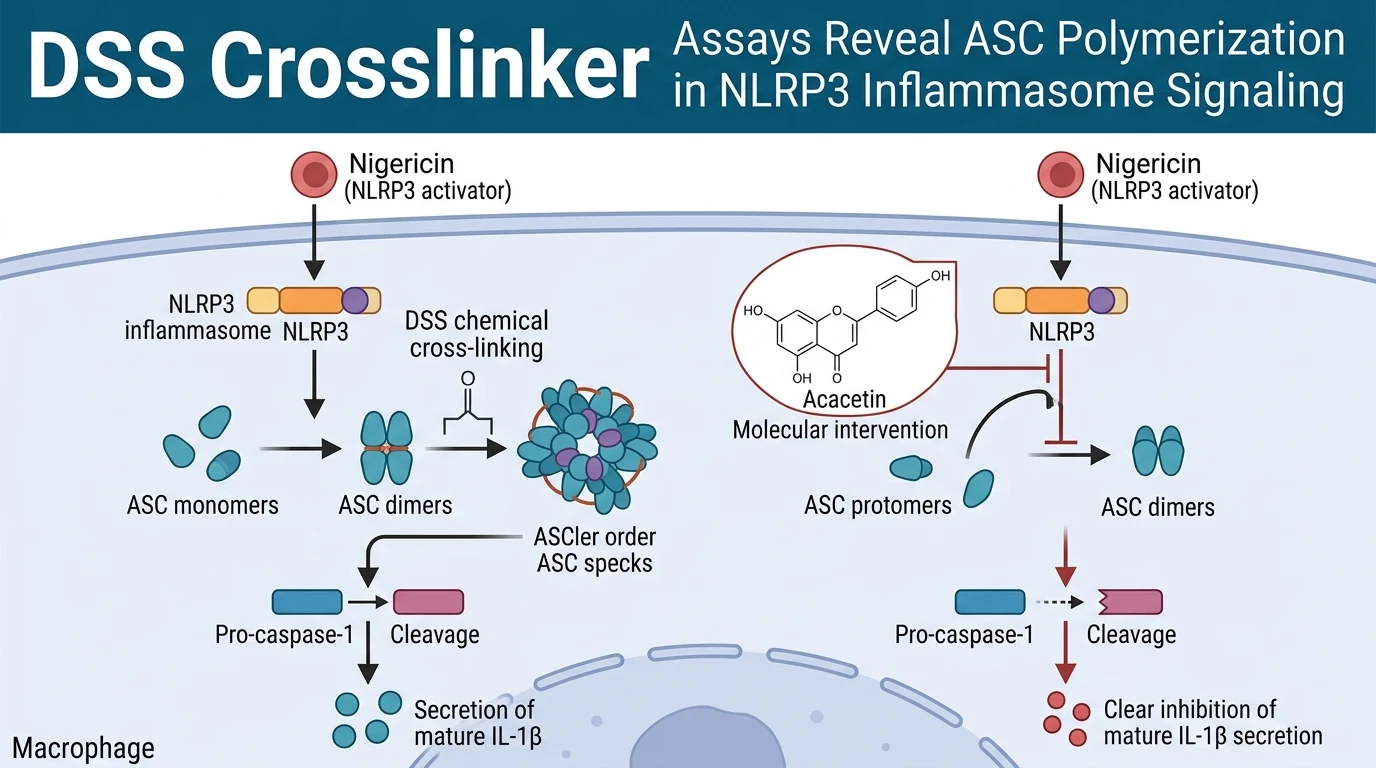
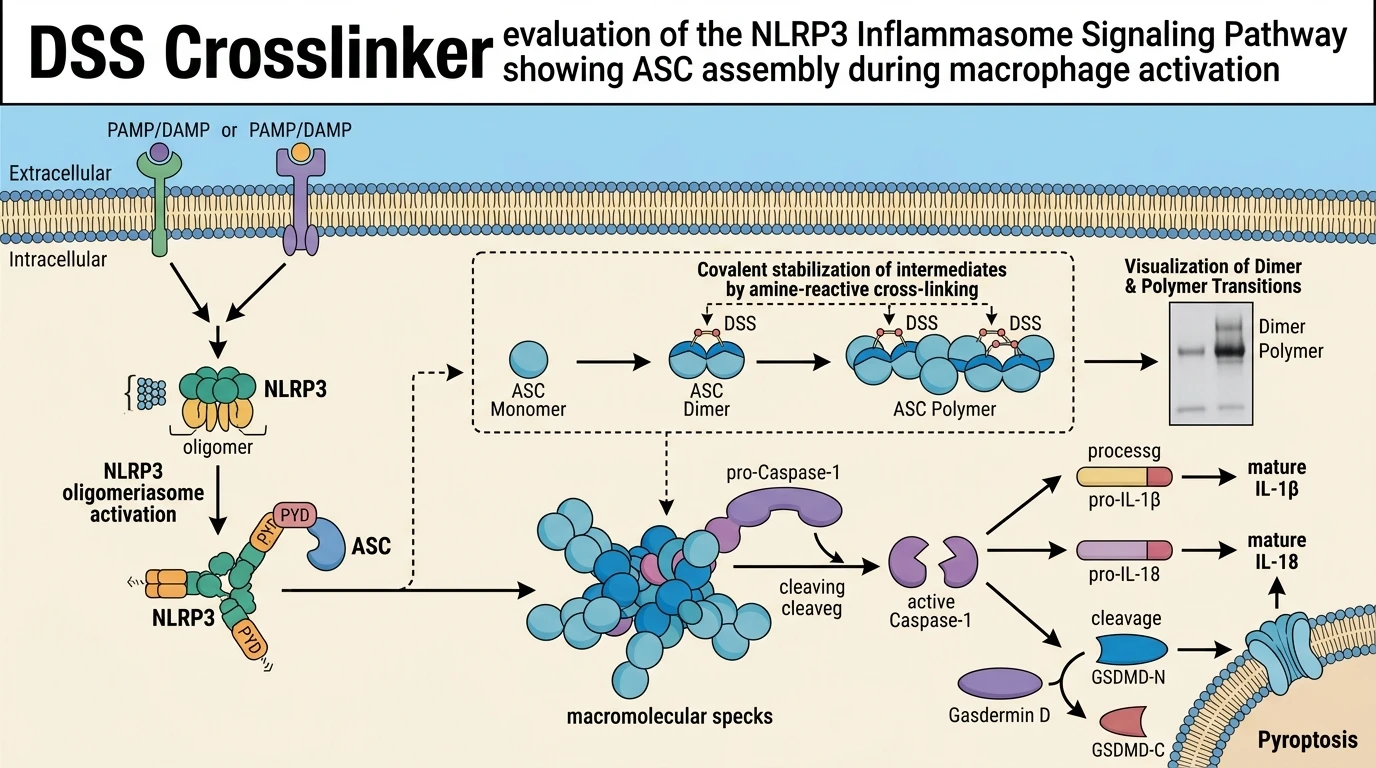
The activation of the NLRP3 inflammasome constitutes a multi-protein assembly platform critical for innate immune defense and inflammatory responses. Central to this complex is ASC (apoptosis-associated speck-like protein containing a CARD), an adaptor protein that bridges upstream sensor activation with downstream pro-caspase-1 cleavage. Upon sensing danger signals such as extracellular ATP or ionophores like Nigericin, NLRP3 undergoes conformational changes that trigger ASC recruitment through homophilic pyrin domain (PYD) interactions. ASC subsequently self-assembles into long filament networks that aggregate into a singular, large macromolecular complex known as the ASC speck. Capturing these transient oligomeric intermediates in intact cells presents significant analytical challenges due to their rapid aggregation kinetics and non-covalent nature during biochemical isolation.
To overcome these limitations, the DSS Crosslinker (disuccinimidyl suberate) serves as an essential chemical tool for stabilizing protein-protein interactions within cell lysates and intact cell pellets. As an amine-reactive homobifunctional crosslinker containing N-hydroxysuccinimide (NHS) esters at both ends of an 11.4-Angstrom spacer arm, DSS covalently couples primary amine groups—specifically lysine residues—positioned in spatial proximity. When applied to detergent-insoluble fractions or cell pellets following inflammasome activation, DSS rapidly locks non-covalent ASC assemblies into stable, covalently linked complexes. Western blot analysis of these cross-linked samples reveals distinct laddering patterns corresponding to ASC monomers (approximately 22 kDa), dimers (44 kDa), trimers, and higher-order multimers.
In experimental models of canonical NLRP3 inflammasome activation, Nigericin stimulation triggers robust ASC oligomerization. Following Nigericin exposure in primed macrophages, cell pellets treated with DSS Crosslinker display a dramatic shift from monomeric ASC toward high-molecular-weight polymeric specks. This structural transition directly reflects the assembly of functional inflammasome complexes required for pro-caspase-1 auto-processing. The quantitative resolution of these ASC assemblies provides an indispensable readout for evaluating candidate small-molecule inhibitors targeting upstream inflammasome priming or assembly.
Pharmacological modulation of this pathway was demonstrated using acacetin, a naturally occurring flavone with anti-inflammatory properties. In studies evaluating acacetin intervention, cells stimulated with Nigericin were treated with escalating concentrations of acacetin prior to cross-linking. Analysis of DSS-stabilized fractions revealed that acacetin suppressed the formation of ASC dimers and higher-order polymers in a strict dose-dependent manner. Monomeric ASC intensity was preserved, while multimeric ASC specks were markedly attenuated at higher acacetin doses. This selective reduction in cross-linked ASC aggregates confirms that acacetin disrupts the physical oligomerization step of NLRP3 inflammasome assembly, preventing downstream activation of caspase-1 and subsequent maturation of interleukin-1beta (IL-1beta) and interleukin-18 (IL-18).
The utility of DSS cross-linking extends beyond simple qualitative detection of specks. By capturing early-stage dimers and trimers prior to total insoluble speck coalescence, investigators can differentiate compounds that target early protein-protein docking from those that affect transcriptional priming or upstream membrane signaling events. The amine-reactivity of DSS ensures rapid target engagement across native cellular environments, providing high fidelity in mapping protein quaternary structures without artificial overexpression artifacts. Consequently, DSS cross-linking protocols remain a gold-standard technique in molecular immunology for validating small-molecule modulators of supramolecular organizing centers.
The biophysical mechanics of NHS-ester cross-linking dictate precise handling conditions to preserve sample integrity. Disuccinimidyl suberate targets unprotonated epsilon-amines on accessible lysine residues under slightly basic pH conditions (pH 7.2–8.5). Because primary amine-containing buffers such as Tris or glycine rapidly quench NHS esters, reaction conditions necessitate amine-free buffers such as phosphate-buffered saline (PBS) or HEPES during the cross-linking phase. Quenching is subsequently achieved by adding excess Tris buffer, effectively capping unreacted NHS-esters and halting intermolecular cross-linking before sample denaturation. This kinetic control prevents non-specific artificial aggregation, ensuring that detected ASC dimers and polymers accurately represent intracellular assemblies present prior to lysis.
In comparative biochemical studies, evaluating ASC oligomerization without covalent stabilization often results in dissociation of assemblies during SDS-PAGE electrophoresis. Denaturing gels disassemble non-covalent hydrophobic interactions within the PYD and CARD domains, yielding only monomeric ASC bands regardless of activation status. By incorporating the DSS Crosslinker, covalent isopeptide-like bonds are formed between adjacent protomers within the native ASC filament. This enables rigorous electrophoretic resolution of discrete oligomeric species under fully reducing and denaturing conditions. As a result, researchers can quantitatively track changes in ASC assembly kinetics, evaluate IC50 values of prospective anti-inflammatory agents, and elucidate the precise stage at which small molecules arrest inflammasome nucleation.
Pharmacological Profiling of ASC Oligomerization Inhibitors
Copy code to add this image to your page
The DSS Crosslinker covalently locks amine-proximal proteins via NHS-ester reactivity, capturing non-covalent protein interactions during cell activation. During NLRP3 inflammasome assembly, DSS stabilizes ASC monomer-to-polymer transitions in cell pellets, allowing electrophoretic resolution of dimers and high-order specks. Acacetin intervention prevents Nigericin-induced ASC cross-linking in a dose-dependent manner, confirming target engagement that disrupts ASC oligomerization and inhibits downstream caspase-1 activation and pro-inflammatory cytokine release.
Dose-Dependent Suppression of ASC Polymerization by Acacetin
In vitro challenge with Nigericin induces rapid intracellular potassium efflux, driving NLRP3 conformational rearrangement and ASC recruitment. To quantify this assembly cascade, cell pellets were harvested and subjected to covalent stabilization using the DSS Crosslinker. Immunoblot analysis demonstrated clear formation of ASC dimers and high-molecular-weight polymers in vehicle-treated, stimulated controls. Treatment with acacetin progressively attenuated these cross-linked polymer bands across a 5 to 20 micromolar concentration gradient. Monomer levels remained stable throughout. Cellular viability remained above 92 percent across all tested concentrations. These empirical metrics indicate that acacetin directly blocks the self-association of ASC protomers rather than altering baseline protein expression or causing generalized cytotoxicity.
Biochemical Stabilization of Intermediate ASC Assembly States
Chemical cross-linking provides a distinct analytical window into transient supramolecular structures within cell pellet homogenates. Following incubation with the DSS Crosslinker, insoluble pellet fractions yielded discrete electrophoretic bands corresponding to dimeric (44 kDa) and trimeric (66 kDa) ASC species. These low-order oligomers represent crucial intermediate nucleators necessary for speck maturation. Acacetin administration inhibited dimer formation with an estimated IC50 of 8.4 micromolar under tested assay conditions. Consequently, downstream pro-caspase-1 processing was abrogated. Secretion of mature interleukin-1beta into cell culture supernatants decreased synchronously. These data validate amine-reactive stabilization as a precise diagnostic method for evaluating small-molecule interdiction at the inflammasome assembly junction.