AZD2811 Barasertib-HQPA targeted inhibition of the Aurora B kinase INCENP complex
Copy code to add this image to your page
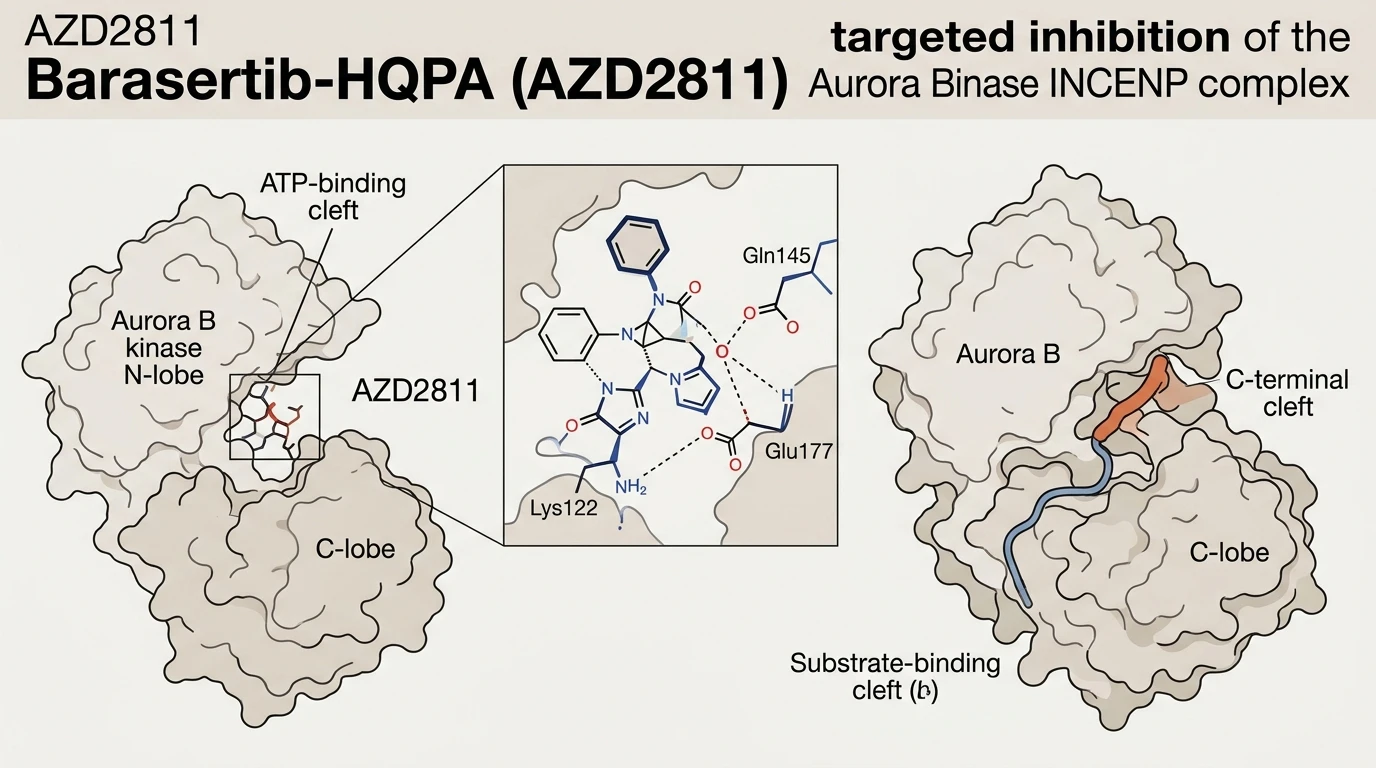
The chromosomal passenger complex coordinates mitotic fidelity across eukaryotic organisms. At the core of this machinery lies Aurora B kinase (Aurora B–INCENP complex), an essential serine/threonine kinase responsible for histone modification, kinetochore-microtubule error correction, and cleavage furrow ingression. Small-molecule targeting of this catalytic core has emerged as a validated therapeutic modality in oncology. Barasertib-HQPA (AZD2811), the active moiety derived from the prodrug barasertib (AZD1152), functions via ATP-competitive inhibition of Aurora B kinase. Structural elucidation of this interaction at atomic resolution provides key insights into isoform selectivity and kinase regulation. High-resolution X-ray crystallography at 1.5 Å resolution of the Xenopus laevis Aurora B–INCENP catalytic domain bound to the inhibitor establishes the precise coordinate architecture of target engagement. In this structural model, AZD2811 inserts deep within the ATP-binding cleft situated between the amino-terminal (N-lobe) and carboxy-terminal (C-lobe) domains of the kinase. The central pyrazoloquinazoline ring system anchors within the hydrophobic adenine pocket, stabilizing the active kinase conformation. Direct contact points include critical hydrogen-bonding interactions with active site residues. Lys122 forms a direct electrostatic connection, while Gln145 and Glu177 coordinate a network of hydrogen bonds mediated through a highly conserved structural water molecule. This water-mediated bridging network stabilizes the drug-protein interface and optimizes thermodynamic binding affinity. A defining characteristic of this compound is its extraordinary enzymatic selectivity profile, exhibiting over 1000-fold higher potency for Aurora B compared to the closely related paralog Aurora A. Comparative structural analysis between the Aurora A and Aurora B active sites clarifies the molecular basis for this preference. Although the catalytic clefts share significant sequence conservation, subtle amino acid substitutions along the hinge region and entry channel dictate distinct steric constraints. In Aurora B, specific side-chain configurations accommodate the extended fluoro-phenoxy moiety of the drug without inducing steric clashes. Conversely, corresponding residue topologies in Aurora A introduce local spatial restrictions that disfavor optimal ligand alignment. This conformational mismatch lowers target affinity for the Aurora A catalytic site, confirming that subtle variations within non-conserved outer-sphere residues drive paralog selectivity. Beyond classic ATP-competitive inhibition, complementary crystallographic studies using the non-hydrolyzable ATP analog AMP-PNP uncovered an unexpected autoregulatory feature. In these crystals, the C-terminal IN-box segment of INCENP engages in a specific intermolecular contact that buries its peptide chain directly within the substrate-binding region of an adjacent Aurora B molecule. This spatial organization physically blocks peptide substrate access. Strikingly, this structural arrangement mirrors the classical transinhibitory mechanism observed in protein kinase A (PKA) regulation by the protein kinase inhibitor (PKI) peptide. In this mode, the IN-box sequence acts as a structural mimic of a canonical substrate, inserting into the catalytic groove to suppress phosphotransfer activity. This transinhibitory interface suggests that at elevated local concentrations within the cell, INCENP can exert a self-regulatory brake on Aurora B catalytic output, adding an intrinsic layer of spatial kinase control during specific mitotic phases.
Structural Selectivity and Allosteric Transinhibition Mechanisms
Copy code to add this image to your page
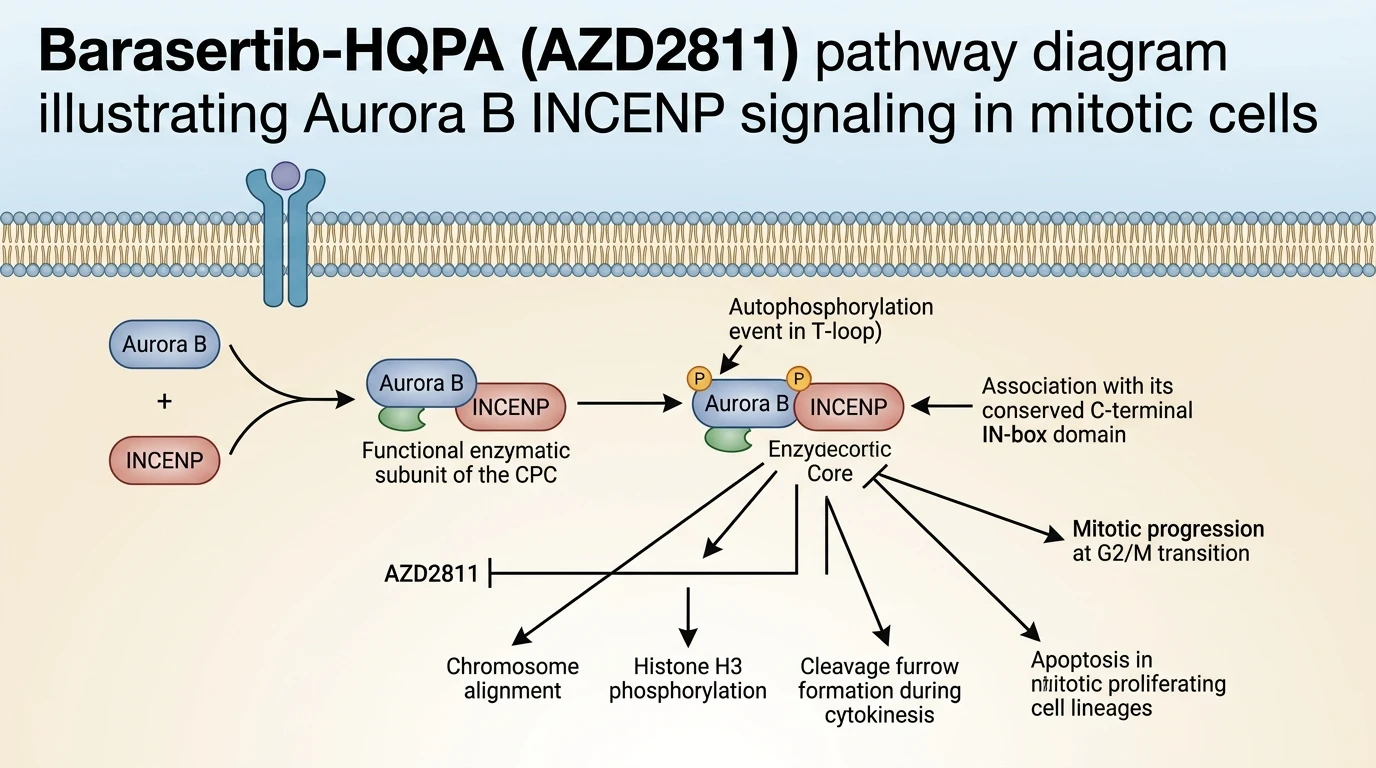
Barasertib-HQPA (AZD2811) operates via ATP-competitive inhibition of Aurora B kinase within the Aurora B–INCENP complex. The compound binds between the N- and C-lobes of the catalytic cleft, forming essential hydrogen bonds with Lys122, Gln145, and Glu177, the latter two via a coordinated water molecule. Paralog selectivity (>1000-fold over Aurora A) stems from minor structural differences within the binding channel. Additionally, the complex exhibits a transinhibitory regulatory mechanism where the C-terminal IN-box of INCENP occupies the substrate site, structurally mimicking PKA inhibition by PKI.
Hydrogen Bonding Networks Drive Aurora B Isoform Selectivity
Structural resolution at 1.5 Å demonstrates that AZD2811 occupies the ATP-binding domain situated between the N- and C-lobes of Aurora B. The binding interaction relies on structured water molecules. Specifically, Lys122 establishes direct contacts, whereas Gln145 and Glu177 participate via water-mediated hydrogen bonds. Kinase assays confirm high specificity. The inhibitor exhibits greater than 1000-fold selectivity for Aurora B over Aurora A under tested in vitro assay conditions. Structural comparisons indicate that spatial constraints within the Aurora A hinge region disfavor identical drug positioning. Consequently, the distinct residue topology of Aurora B allows tight ligand packing without localized structural distortion.
IN-Box Segment Occupancy Mimics PKA Substrate Transinhibition
Crystallographic analysis with AMP-PNP revealed an unexpected protein contact interface. The C-terminal IN-box segment of INCENP inserts directly into the substrate-binding cleft of a neighboring Aurora B catalytic domain. Substrate binding ceases upon segment insertion. This conformational arrangement structurally mimics the inhibition of protein kinase A by PKI. Under high local protein concentrations, this interaction provides an extrinsic auto-regulatory threshold. Kinetic models suggest this transinhibitory mechanism limits unchecked phosphorylation outside target centromeric zones within this specific cellular context. Thus, AZD2811 targets a kinase complex governed by complex intra- and intermolecular inhibitory loops.