GSK1349572 (Dolutegravir) GSK1349572 Integrase inhibitor Targeting HIV-1 Integrase Strand Transfer Mechanism
Copy code to add this image to your page
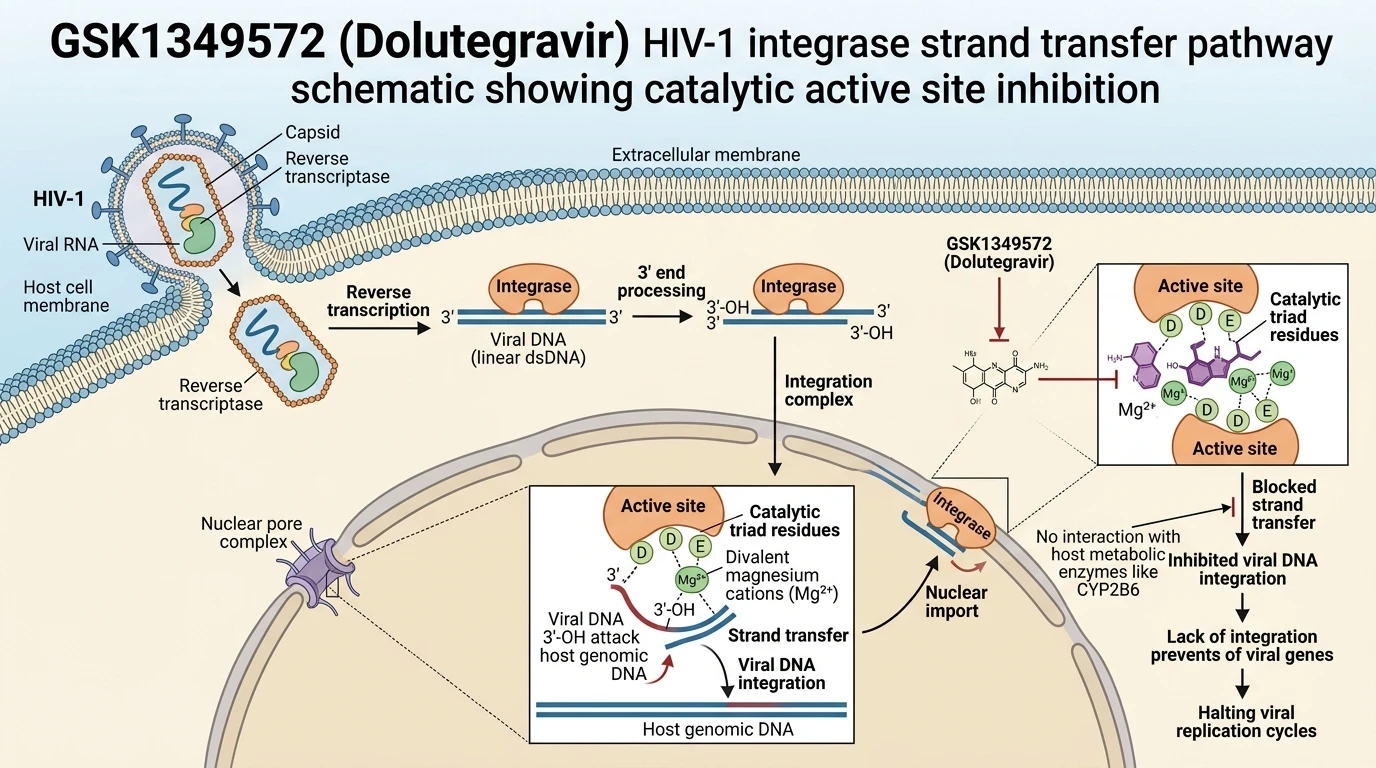
Direct inhibition of HIV-1 integrase represents a clinical standard in antiretroviral therapy for treatment-naive individuals. GSK1349572 (Dolutegravir) functions as a second-generation Integrase Strand Transfer Inhibitor (InSTI), engineered to bind divalent magnesium ions within the active catalytic domain of the viral enzyme. This targeted binding prevents the covalent insertion of reverse-transcribed viral DNA into the host genome, thereby halting viral replication at a crucial genomic junction. While early clinical adoption established superior virological suppression and a high barrier to resistance, subsequent observational data highlighted an unexpected divergence in body weight trajectories among patients initiating dolutegravir-based regimens compared to non-nucleoside reverse transcriptase inhibitor (NNRTI) controls, specifically efavirenz. Initial hypotheses speculated that dolutegravir might exert intrinsic metabolic off-target actions or stimulate central appetite pathways. However, emerging pharmacogenomic evidence from randomized clinical evaluations reframes this clinical observation.
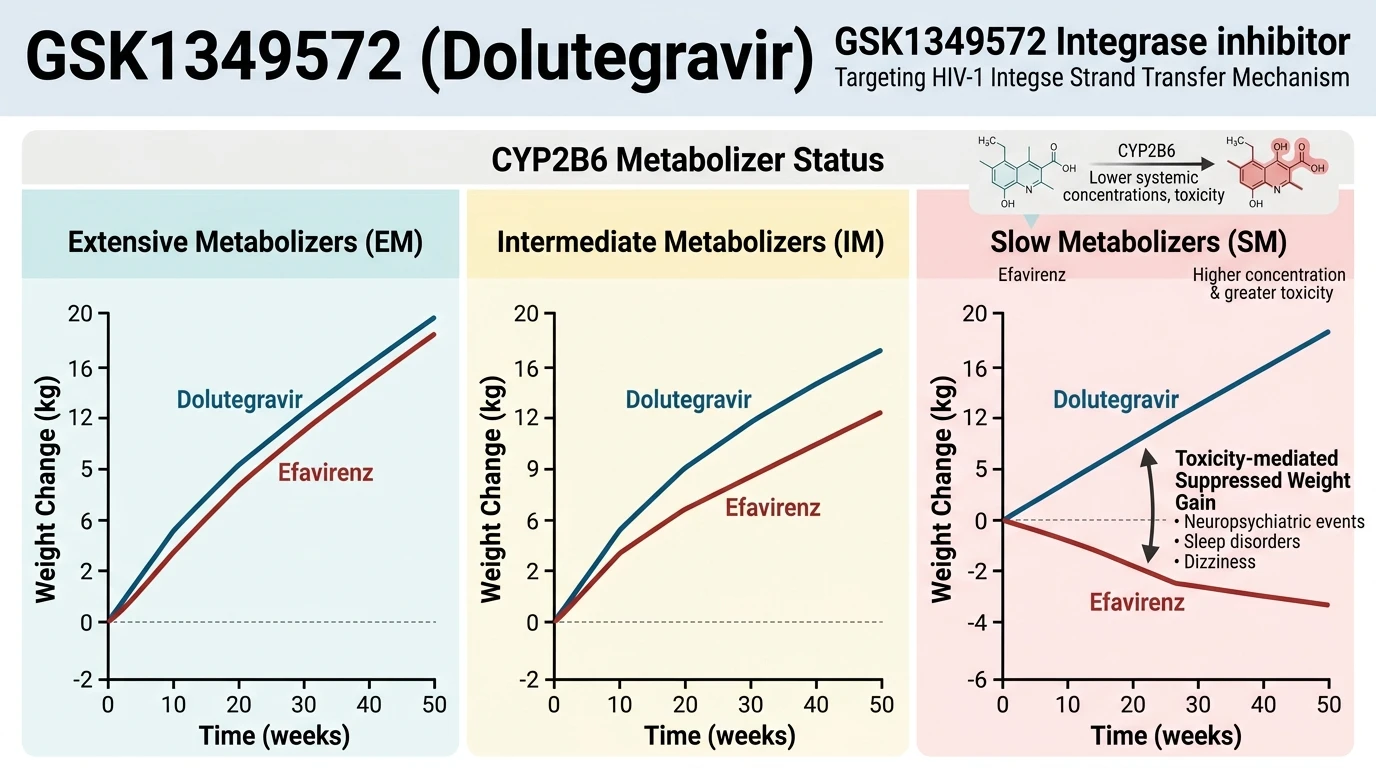
Evaluation of treatment-naive participants enrolled in the landmark ADVANCE trial provided a rigorous biological framework to test these contrasting clinical hypotheses. Investigators stratified study subjects according to cytochrome P450 2B6 (CYP2B6) metabolizer genotypes to isolate drug exposure variables. CYP2B6 serves as the primary hepatic enzyme responsible for oxidative clearance of efavirenz. Genotypic variants encoding reduced enzyme activity give rise to intermediate and slow metabolizer phenotypes, which exhibit dramatically elevated plasma efavirenz concentrations under standard dosing protocols. When researchers analyzed post-baseline weight change across these distinct genotypic strata, a precise pharmacological pattern emerged. Among CYP2B6 extensive metabolizers—individuals possessing normal hepatic drug clearance capacity—mean body weight gain in the efavirenz cohort was statistically indistinguishable from that observed in the GSK1349572 (Dolutegravir) treatment arm (P = .836).
Conversely, marked differences in post-treatment weight accumulation were restricted to patients classified as CYP2B6 slow or intermediate metabolizers. In these slow-clearing sub-cohorts, patients assigned to efavirenz exhibited severe bluntings of weight accumulation or experienced active systemic weight loss over follow-up periods. Mechanistic interpretation of these pharmacokinetic-pharmacodynamic interactions indicates that concentration-dependent drug toxicity drives the suppression of physiological weight recovery. Elevated sustained exposure to efavirenz induces chronic low-grade gastrointestinal disturbances, subclinical neuropsychiatric toxicities, and cellular metabolic strain, which collectively impede normal nutritional retention. Consequently, the apparent superiority of weight gain in patients receiving the GSK1349572 Integrase inhibitor reflects a non-suppressed return to baseline health status rather than an active drug-induced metabolic alteration.
These pharmacogenomic findings resolve a central debate surrounding modern antiretroviral therapy. The perceived weight-stimulating effect attributed to GSK1349572 (Dolutegravir) does not stem from direct interaction with host adipocyte differentiation pathways or central metabolic receptors. Instead, the weight differentials observed in broad clinical trials are largely artifacts of drug toxicity in control groups harboring impaired efavirenz metabolism. By establishing that dolutegravir exhibits intrinsic metabolic neutrality across distinct genetic backgrounds, these data reinforce the safety profile of HIV-1 integrase strand transfer inhibition in diverse clinical populations.
Pharmacogenomic Evaluation and Metabolic Outcome Analysis
Copy code to add this image to your page
GSK1349572 (Dolutegravir) functions as an HIV-1 integrase strand transfer inhibitor by chelating magnesium ions in the catalytic domain of viral integrase. This blocks viral DNA integration into host DNA. Comparative weight gain findings in trial cohorts stem from efavirenz toxicities in CYP2B6 slow metabolizers rather than intrinsic off-target metabolic effects of dolutegravir.
CYP2B6 Metabolizer Genotype Moderates Efavirenz-Associated Weight Dynamics
Hepatic oxidation via CYP2B6 dictates plasma clearance of efavirenz. Patients carrying loss-of-function alleles exhibit impaired drug clearance and prolonged systemic exposure. In the ADVANCE trial, slow metabolizers on efavirenz gained markedly less weight than extensive metabolizers. Indeed, elevated drug concentrations correlate directly with gastrointestinal distress and mitochondrial inhibition. These systemic toxicities suppress caloric intake and normal metabolic gain. The observed weight blunting represents a secondary manifestation of drug-induced cellular toxicity. In contrast, extensive metabolizers cleared the drug efficiently and maintained physiological weight trajectories.
Dolutegravir Maintains Intrinsic Metabolic Neutrality Across Genetic Strata
Direct inhibition of viral integration does not impact host lipid storage. The GSK1349572 Integrase inhibitor exhibited consistent weight trajectories across all CYP2B6 genotypic categories. Statistical parity between dolutegravir and efavirenz was achieved in extensive metabolizers (P = .836). This finding refutes hypotheses claiming dolutegravir stimulates adipogenesis through off-target binding. The compound preserves normal metabolic homeostasis without disrupting systemic energy balance. Consequently, observed weight increases in treated individuals reflect health restoration following viral clearance rather than active pharmacodynamic weight stimulation.