Alectinib (CH5424802) from Selleck Targets ALK Kinase Domain in Rare NSCLC Fusions
Copy code to add this image to your page
Anaplastic lymphoma kinase (ALK) gene rearrangements define a distinct molecular subset of non-small cell lung cancer (NSCLC), accounting for approximately 3% to 5% of advanced cases. Canonical EML4-ALK fusions represent the majority of these alterations. However, next-generation sequencing (NGS) platforms continuously identify rare non-EML4 fusion partners, such as STRN and LMO7. Alectinib (CH5424802) is a highly potent, ATP-competitive, second-generation ALK tyrosine kinase inhibitor designed to overcome central nervous system progression and specific crizotinib-resistance mutations. The compound demonstrates selective inhibition of ALK kinase activity with low nanomolar IC50 values. Database records at the IUPHAR/BPS Guide to PHARMACOLOGY detail the structural interactions within the ATP-binding pocket of ALK that confer this high selectivity over other receptor kinases.
Despite high baseline response rates in patients harboring standard EML4-ALK rearrangements, therapeutic outcomes in patients carrying rare fusion variants display pronounced heterogeneity. In clinical practice, evaluating first-line efficacy requires evaluating both the structural structural properties of the fusion chimera and concurrent genomic alterations. Utilizing high-quality reference compounds such as Alectinib (CH5424802) from Selleck enables precise benchmarking of kinase inhibition profiles against non-canonical target conformations in preclinical models.
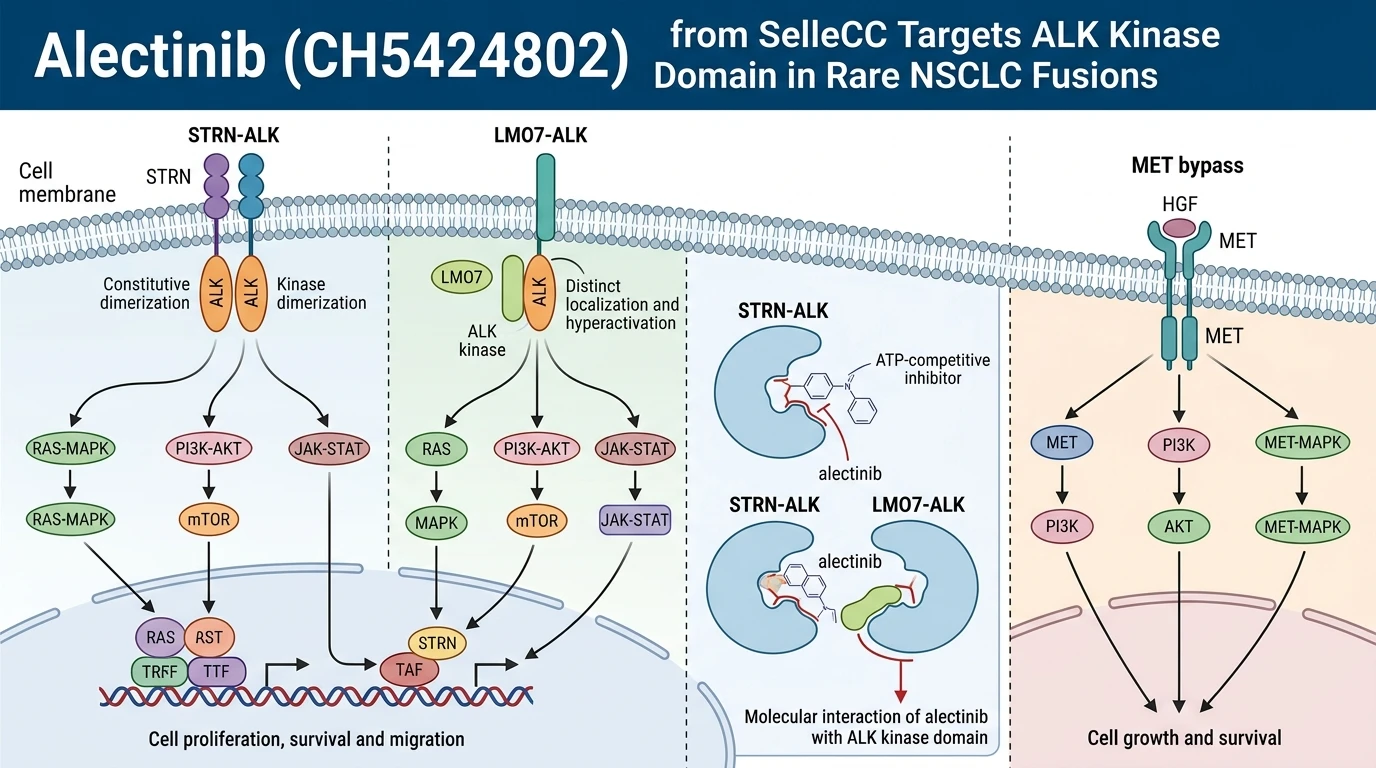
Recent clinical findings demonstrate that rare ALK fusions can lead to atypical drug sensitivities or primary therapeutic failure. For instance, in a patient harboring a striatin (STRN)-ALK fusion alongside focal MET gene amplification, first-line alectinib administration yielded a progression-free survival (PFS) of only 4 months. Progression occurred due to activation of parallel receptor tyrosine kinase signaling via the MET axis, which bypassed ALK blockade. Subsequent treatment with crizotinib—a multikinase inhibitor targeting both ALK and MET—effectively neutralized this parallel driver, achieving significant disease regression and prolonged response. This clinical observation demonstrates that MET co-amplification functions as an active bypass driver, restricting alectinib mono-therapy efficacy regardless of ALK inhibition potency.
In another notable clinical scenario, a patient presenting with a novel LMO7-ALK fusion demonstrated primary resistance to first-line alectinib. Biochemical modeling indicates that distinct N-terminal fusion partners alter tertiary protein folding, cellular localization, and kinase domain accessibility. These structural alterations can attenuate binding affinity for specific TKIs. Following rapid disease progression on alectinib, switching to second-line ensartinib produced durable radiological response and disease control. Ensartinib possesses a distinct chemical scaffold capable of engaging the catalytic cleft despite steric alterations imposed by the LMO7 partner.
These divergent clinical trajectories highlight that ALK-rearranged NSCLC is not a monolithic disease entity. Molecular partners modulate baseline kinase activity, protein stability, and downstream signaling kinetics. Furthermore, co-occurring genomic alterations, such as MET amplification or TP53 mutations, alter the evolutionary landscape under selective drug pressure. Comprehensive NGS panels capturing genomic breakpoints, copy number variants, and concurrent mutations are essential for predicting treatment response. Preclinical evaluation using purified ATP-competitive inhibitors like Alectinib (CH5424802) from Selleck provides crucial mechanistic reference data for translating genomic profiling into personalized treatment sequences.
Kinase Inhibition Profiles and Resistance Dynamics in Heterogeneous Fusions
Copy code to add this image to your page
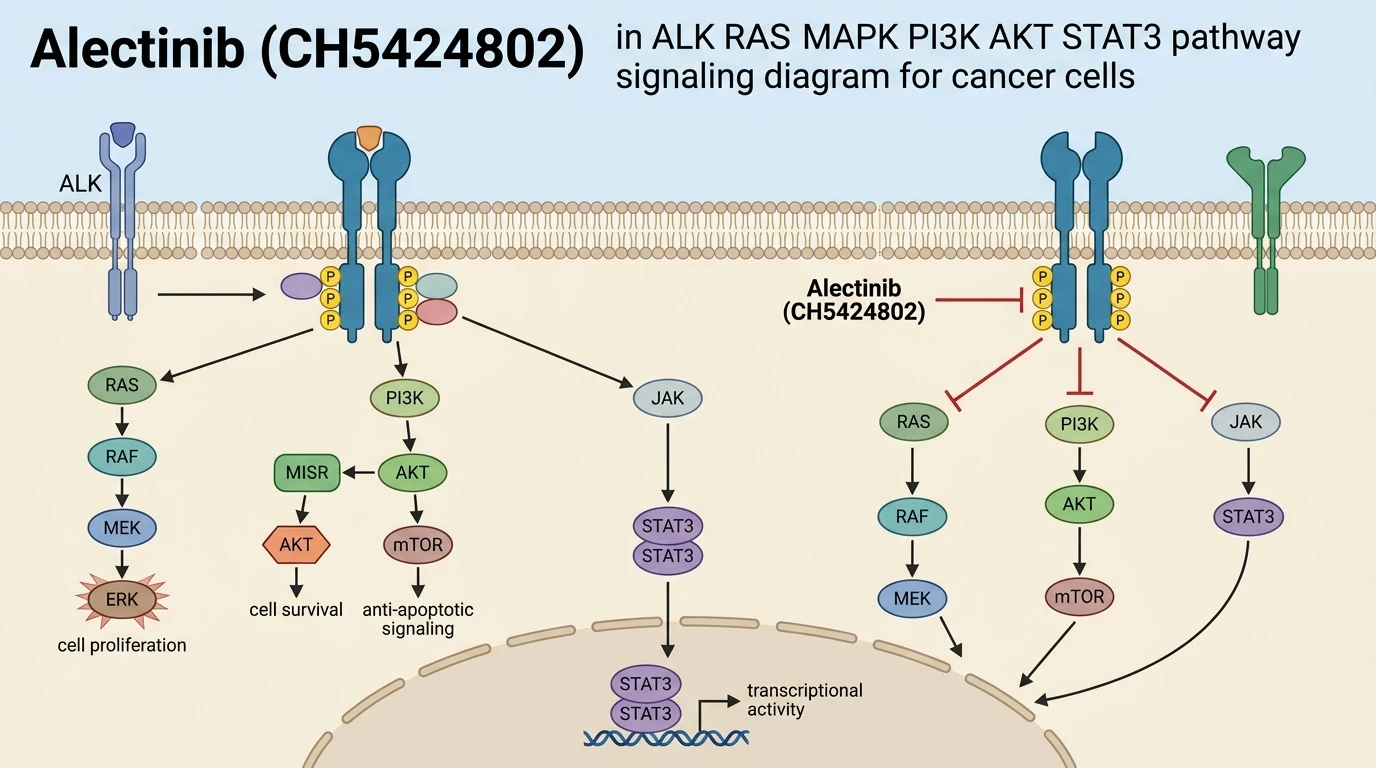
Alectinib (CH5424802) selectively binds the ATP-binding pocket of active ALK kinase, preventing autophosphorylation and halting downstream activation of the RAS-RAF-MEK-ERK, PI3K-AKT-mTOR, and JAK-STAT3 cascades. While highly effective against standard EML4-ALK constructs, its efficacy varies in rare fusion variants such as STRN-ALK or LMO7-ALK. Resistance can arise through target pocket conformational changes or parallel driver activation via MET gene amplification.
STRN-ALK Fusion and MET Amplification Mediate Rapid Alectinib Progression
Co-occurring genomic alterations alter clinical responses to targeted ALK inhibition. In patients harboring the STRN-ALK fusion variant alongside MET amplification, first-line treatment with Alectinib (CH5424802) from Selleck resulted in rapid disease progression within 4 months. Biochemical analysis reveals that MET amplification establishes an independent signaling pathway. MET activates downstream RAS-MEK and PI3K-AKT cascades even when ALK phosphorylation is suppressed. Switch to crizotinib achieved clinical control because crizotinib inhibits both ALK and MET kinase domains simultaneously.
Novel LMO7-ALK Rearrangement Induces Primary Resistance Overcome by Ensartinib
Structural features of fusion partners directly affect drug binding. A novel LMO7-ALK rearrangement exhibited complete primary resistance to alectinib. Spatial orientation of the LMO7 domain alters ATP-binding pocket conformation. This steric alteration reduces the association rate of alectinib. Subsequent administration of ensartinib restored therapeutic control. Ensartinib retains high binding affinity against altered ALK conformations.
Next-Generation Sequencing Uncovers Fusion Partner Heterogeneity and Therapeutic Vulnerabilities
Comprehensive genomic profiling remains essential before selecting second-generation TKIs. Rare fusion partners account for distinct drug response profiles observed across clinical cohorts. Using Alectinib (CH5424802) from Selleck in functional target assays confirms that kinase inhibition levels vary depending on partner-induced dimerization mechanics. Standard PCR assays miss novel rearrangements. Next-generation sequencing identifies specific breakpoints and concurrent copy-number variations accurately.