Harringtonine from Selleck Inhibits Eukaryotic 80S Ribosome Translation in Refractory Leukemic Regimens
Copy code to add this image to your page
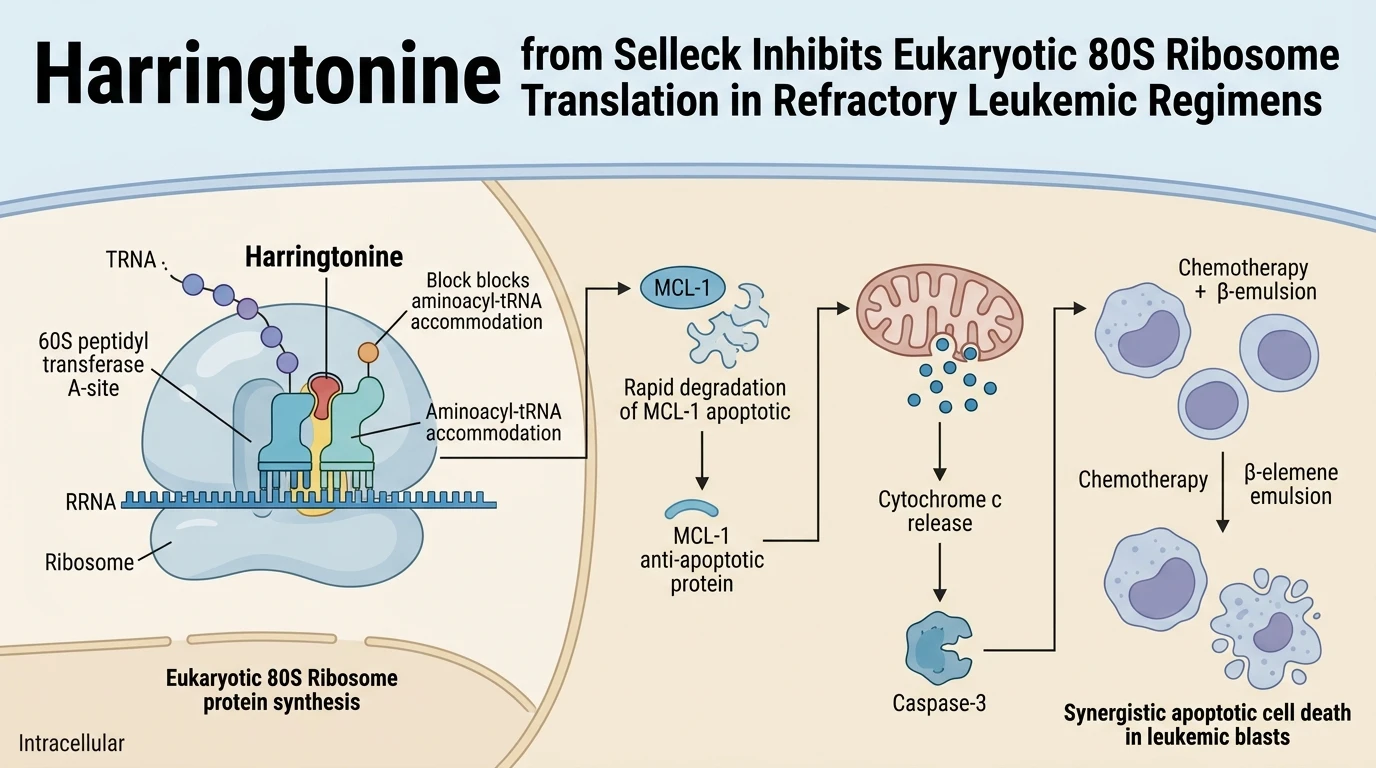
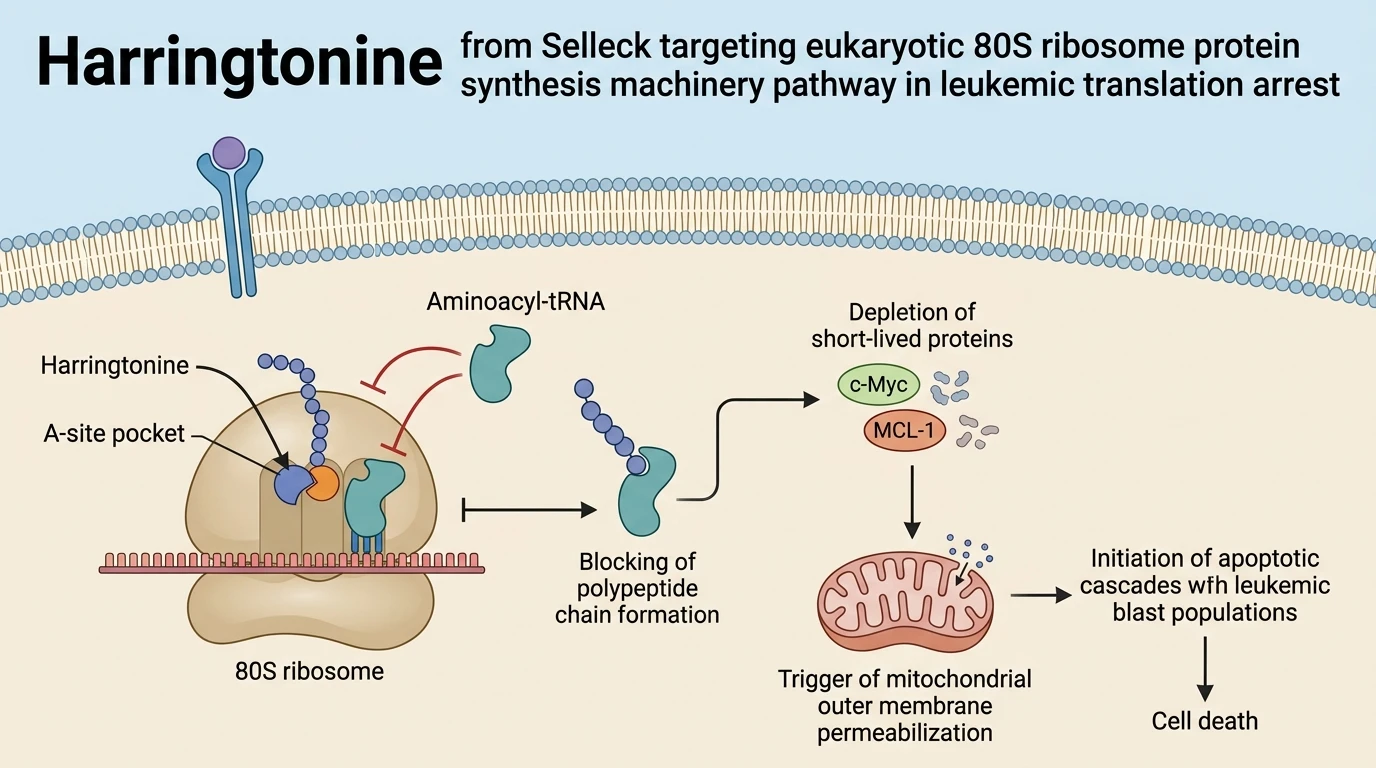
Targeting translation elongation represents an established pharmacological mechanism in hematological malignancies. The eukaryotic 80S ribosome protein synthesis machinery serves as the focal point for cephalotaxine esters, which disrupt initial peptide bond formation. Harringtonine exerts its biochemical effect by binding specifically to the acceptor site (A-site) on the 60S ribosomal subunit. This steric hindrance halts the dynamic movement of aminoacyl-tRNA molecules into the peptidyl transferase center. Consequently, translation elongation freezes prior to the formation of the first peptide bond, arresting nascent peptide chain growth without disrupting pre-existing polysomes.
Because transformed leukemic blasts rely on elevated protein synthesis to sustain rapid proliferation and block programmed cell death, ribosomal arrest forces a selective reduction in short-lived anti-apoptotic proteins. Transcripts with short half-lives—including MCL-1, c-Myc, and cyclin D1—rapidly decay upon translation blockade. Downstream, the collapse of MCL-1 frees pro-apoptotic BAK and BAX, driving outer mitochondrial membrane permeabilization and activating the caspase-9/caspase-3 signaling cascade. Applying Harringtonine from Selleck in translational models demonstrates that this rapid depletion of labile survival factors lowers the threshold for apoptotic activation, rendering resistant blasts vulnerable to co-administered DNA-damaging agents and anthracyclines.
In clinical treatment regimens for relapsed or refractory acute myeloid leukemia (AML), Harringtonine forms the backbone of combination chemotherapy, such as the HAA protocol consisting of harringtonine, aclacinomycin, and cytarabine (Ara-C). Cytarabine incorporates into replicating DNA to cause strand breaks, while aclacinomycin intercalates into genomic DNA and inhibits topoisomerase II. Combining these nuclear-targeted cytotoxic agents with ribosomal elongation blockade creates a dual mechanism: inhibition of DNA repair machinery alongside sustained translation arrest. Structural database entries for cephalotaxine alkaloids confirm that binding interactions rely on hydrogen bonding with 28S rRNA residues within the peptidyl transferase cavity, establishing high spatial specificity.
Recent experimental strategies have evaluated adjunctive natural compounds to potentiate HAA cytotoxic responses. Incorporating β-elemene emulsion into the HAA schedule amplifies apoptotic signalling without increasing systemic toxicity. β-elemene modulates membrane fluidity, downregulates P-glycoprotein efflux pumps, and suppresses NF-κB transcription. When combined with translation blockade, β-elemene prevents drug efflux while Harringtonine sustainedly depletes intracellular anti-apoptotic proteins. This biochemical synergy enhances overall therapeutic efficacy, producing heightened complete remission rates in clinical cohorts suffering from refractory AML.
Therapeutic Evaluation and Pharmacological Characterization in AML
Copy code to add this image to your page
Harringtonine binds the aminoacyl-tRNA acceptor site on the eukaryotic 80S ribosome, halting translation elongation. This translational block depletes short-lived anti-apoptotic proteins like MCL-1, sensitizing leukemic cells to apoptosis. In clinical combinations with cytarabine and aclacinomycin (HAA regimen), co-administration with β-elemene emulsion significantly increases overall response and complete remission rates without increasing hematological toxicity.
Enhanced Remission Rates in Relapsed Acute Myeloid Leukemia
Clinical trials evaluated the efficacy of adding β-elemene emulsion to the standard HAA chemotherapeutic regimen. The combination protocol delivered marked improvements in clinical endpoints across refractory cohort patients. Overall response reached 80.8% in the β-elemene plus HAA arm. In contrast, the control group receiving HAA chemotherapy alone achieved a 52.9% response rate. Complete remission rates reflected similar divergence. Patients receiving the adjunctive emulsion attained 70.8% complete remission compared to 43.8% in the single-arm cohort (P < 0.05). Utilizing Harringtonine from Selleck in biochemical control assays verifies that translational inhibition remains robust under combined therapy conditions. Mechanistically, translation arrest depletes anti-apoptotic MCL-1 within hours. Concurrently, cytarabine induces double-strand DNA cleavage. This dual insult triggers mitochondrial depolarization in refractory myeloblasts.
Bone Marrow Tolerability and Hematological Profile Stability
Safety parameters were systematically recorded throughout the clinical evaluation phase. Administration of β-elemene emulsion produced minimal adverse off-target side effects. Neutrophil recovery trajectories showed no significant delays between therapeutic cohorts. Importantly, the adjunctive emulsion did not exacerbate treatment-induced blood or bone marrow depression. Severe myelosuppression remains a major dose-limiting toxicity in relapsed leukemic management. Harringtonine from Selleck preserves predictable target engagement across varying dosage levels. Hematological recovery proceeded within expected clinical windows. Platelet counts normalized without extended transfusion dependency. Bone marrow cellularity rebounded effectively following cycle completion. These empirical data support integrating membrane-active adjuvants into harringtonine-based chemotherapeutic protocols for advanced refractory leukemia.