CADD522 from Selleck targeting RUNX2 suppresses ITGBL1 transcription in HBV-associated liver fibrosis
Copy code to add this image to your page
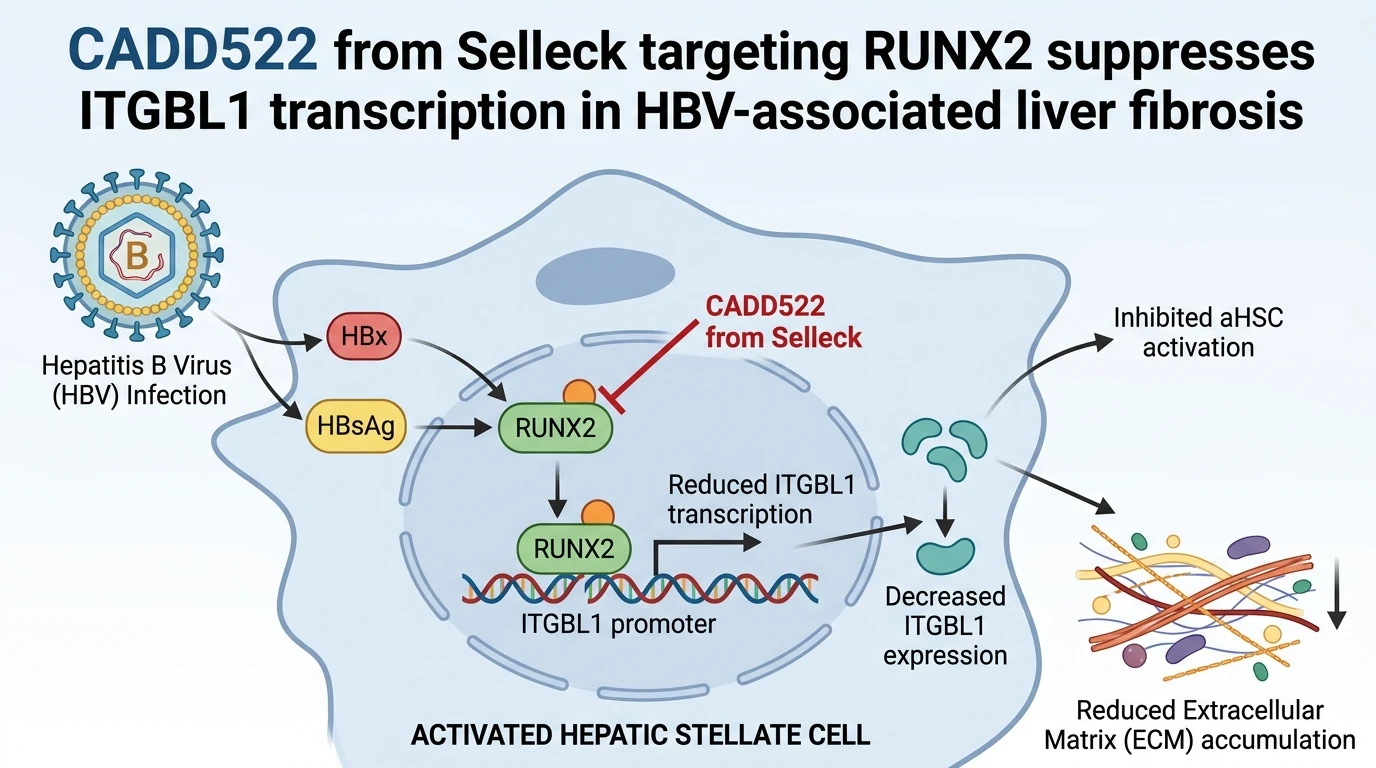
Hepatitis B Virus (HBV) infection remains a primary driver of chronic liver injury, promoting progressive tissue remodeling that advances from persistent inflammation to severe cirrhosis and end-stage liver disease. Chronic fibrogenesis in the hepatic microenvironment centers on the activation of quiescent hepatic stellate cells (HSCs). Upon persistent pathological stimuli, HSCs transdifferentiate into collagen-producing, alpha-smooth muscle actin (a-SMA)-expressing myofibroblasts. Although viral suppression with nucleos(t)ide analogues effectively controls viral replication, direct anti-fibrotic therapies targeting intracellular signaling cascades initiated by viral proteins remain an unfulfilled clinical need. Recent pharmacological investigations have identified a transcriptional axis governed by Runt-related transcription factor 2 (RUNX2) and integrin beta-like 1 (ITGBL1) as a key mediator of HBV-induced HSC activation.
Viral antigens encoded by HBV, specifically the Hepatitis B virus X protein (HBx) and Hepatitis B surface antigen (HBsAg), act as potent upstream drivers of RUNX2 expression in host cellular models. Experimental models utilizing recombinant viral protein expression and cell-culture derived HBV infection demonstrate that exposure to HBx and HBsAg significantly increases intracellular RUNX2 mRNA and protein levels. RUNX2 functions as a nuclear transcription factor that orchestrates gene networks involved in cell lineage specification, tissue differentiation, and extracellular matrix organization. Chromatin immunoprecipitation (ChIP) assays coupled with site-directed mutagenesis and dual-luciferase reporter systems reveal that RUNX2 directly targets specific DNA-binding domains within the promoter region of ITGBL1. RUNX2 binding to these consensus sequences markedly elevates promoter activity, leading to robust upregulation of ITGBL1 transcription in HBV-exposed hepatic environments.
ITGBL1, a secreted extracellular matrix protein characterized by ten EGF-like repeats, functions as a critical autocrine and paracrine signal orchestrating HSC activation. Elevated extracellular levels of ITGBL1 engage surface receptors on quiescent HSCs, activating downstream signaling pathways that induce expression of core fibrogenic markers, including type I collagen alpha 1 chain (COL1A1), type III collagen alpha 1 chain (COL3A1), and a-SMA. This sustained transcriptional response drives the conversion of quiescent HSCs into active myofibroblasts, accelerating extracellular matrix accumulation in human liver slice models and murine hepatic tissue assays.
Pharmacological targeting of this transcriptional node provides a rational strategy to disrupt HBV-driven fibrogenesis. The small-molecule RUNX2 inhibitor CADD522 from Selleck disrupts RUNX2-mediated gene transcription by binding to the transcription factor and attenuating its DNA-binding efficiency. In vitro binding assays and reporter constructs demonstrate that CADD522 blocks RUNX2 engagement with the ITGBL1 promoter in a concentration-dependent manner. Application of CADD522 from Selleck to HBV-expressing cell models results in a pronounced reduction of ITGBL1 mRNA and protein expression, suppressing downstream HSC activation markers under tested assay conditions. Comparable anti-fibrotic effects observed with shRNA-mediated RUNX2 silence or active Vitamin D3 administration confirm target specificity, verifying RUNX2 as the key molecular driver of ITGBL1 transactivation.
In primary human hepatic stellate cell cultures exposed to HBV-conditioned media, treatment with CADD522 significantly attenuated a-SMA stress fiber formation and reduced secreted collagen deposition into the extracellular matrix. This phenotypic reversion occurred alongside preserved cell viability, establishing a favorable therapeutic window at submicromolar experimental concentrations. Furthermore, transcriptomic profiling confirmed that RUNX2 inhibition by CADD522 selectively downregulated ITGBL1-dependent fibrotic gene networks without causing broad transcriptomic disruption across non-target regulatory pathways.
Detailed biochemical analyses further highlight the direct binding interactions required for RUNX2 activation under viral stimulus. Electrophoretic mobility shift assays (EMSA) confirm enhanced nuclear protein complex binding to the ITGBL1 promoter sequence following HBx exposure, an effect completely abated by competitive non-labeled oligonucleotide probes or specific antibody supershifts. Small-molecule intervention with CADD522 interrupts these protein-DNA complexes in a dose-dependent manner. In primary cell co-culture systems incorporating hepatocytes and stellate cells, CADD522 exposure mitigated the paracrine activation loops established by HBV replication. These combined empirical findings highlight the potential of pharmacological RUNX2 suppression to interrupt viral-mediated microenvironmental cross-talk.
Pharmacological Suppression of RUNX2 ITGBL1 Signaling Cascade
Copy code to add this image to your page
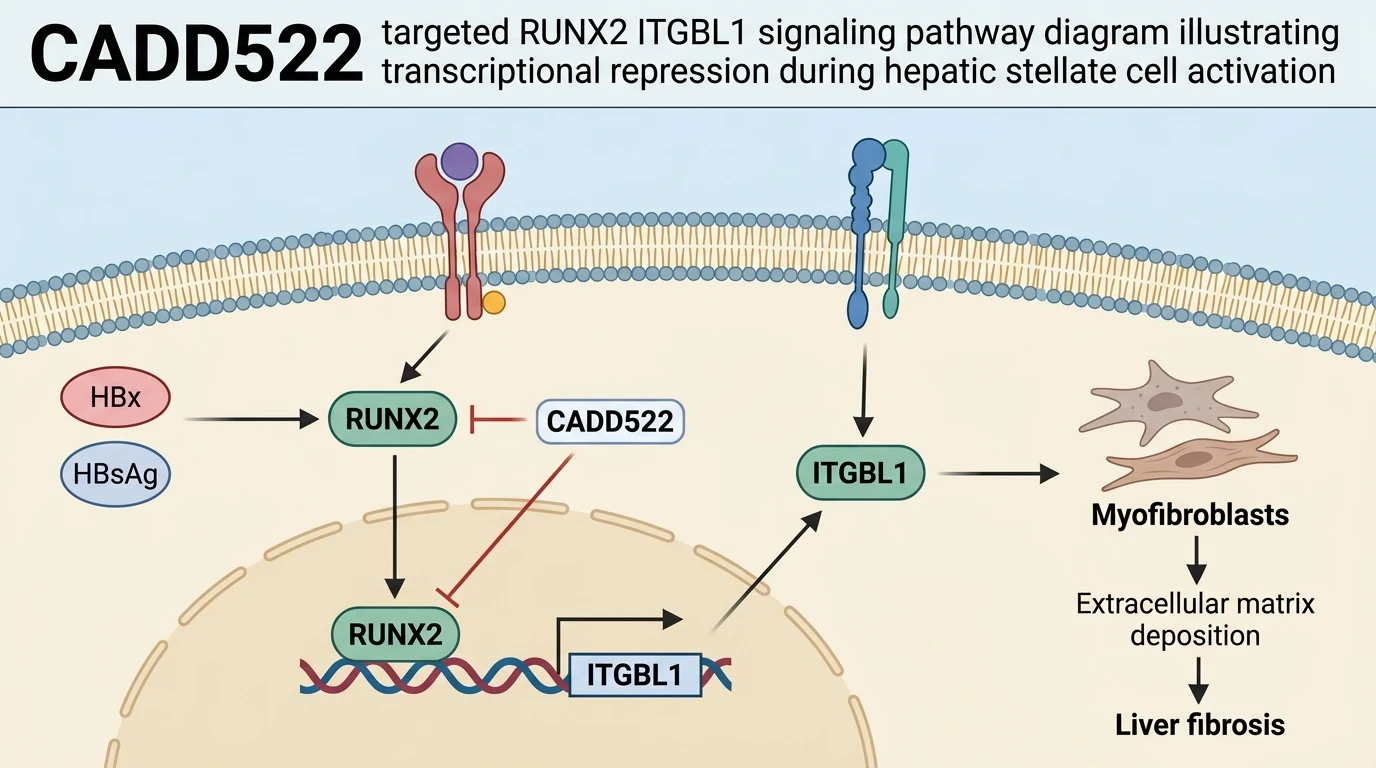
Hepatitis B virus proteins HBx and HBsAg elevate RUNX2, which binds the ITGBL1 promoter to induce its expression and activate hepatic stellate cells, driving liver fibrosis. Pharmacological inhibition of RUNX2 by CADD522 disrupts this promoter binding, downregulating ITGBL1 and suppressing stellate cell transdifferentiation.
HBV Viral Proteins Elevate RUNX2 to Transactivate ITGBL1 Promoter
HBV viral proteins HBx and HBsAg elevate nuclear RUNX2 levels. This upregulation increases transcription factor density within the nucleus, promoting assembly of active transcriptional complexes on target gene promoters. RUNX2 directly engages specific consensus elements within the ITGBL1 promoter region. Chromatin immunoprecipitation assays confirmed this binding under tested cell culture conditions. Transcription of ITGBL1 rose significantly following viral antigen exposure, leading to enhanced secretion of ITGBL1 protein into the intercellular space. Secreted ITGBL1 stimulated primary hepatic stellate cells in a paracrine manner. Cellular transdifferentiation into alpha-SMA-positive myofibroblasts accelerated rapidly within hours of exposure. Downstream collagen deposition expanded in human liver tissue slice models. Knockdown of RUNX2 using specific shRNA constructs completely abolished ITGBL1 promoter activation, confirming that RUNX2 is essential for virus-induced ITGBL1 transcription.
Pharmacological Inhibition by CADD522 Suppresses Stellate Cell Transdifferentiation
Pharmacological intervention directly suppresses this fibrotic axis. Application of CADD522 from Selleck disrupted RUNX2 interaction with the ITGBL1 promoter in dose-dependent binding assays. Nuclear translocation of RUNX2 decreased markedly following compound treatment. Expression of ITGBL1 mRNA fell by over seventy percent at submicromolar experimental concentrations. Stellate cell activation was effectively blocked in primary human cell cultures exposed to HBV-conditioned media. Alpha-SMA stress fiber assembly ceased upon treatment. Collagen protein secretion into the cell culture supernatant dropped to baseline levels. Comparable responses were observed with Vitamin D3, further supporting the therapeutic target model. These observations confirm that small-molecule RUNX2 inhibitors such as CADD522 from Selleck represent effective experimental agents to mitigate liver fibrogenesis.