Monastrol Inhibition of Kinesin-5 (Eg5) Accelerates Axonal Regeneration and Peripheral Remyelination
Copy code to add this image to your page
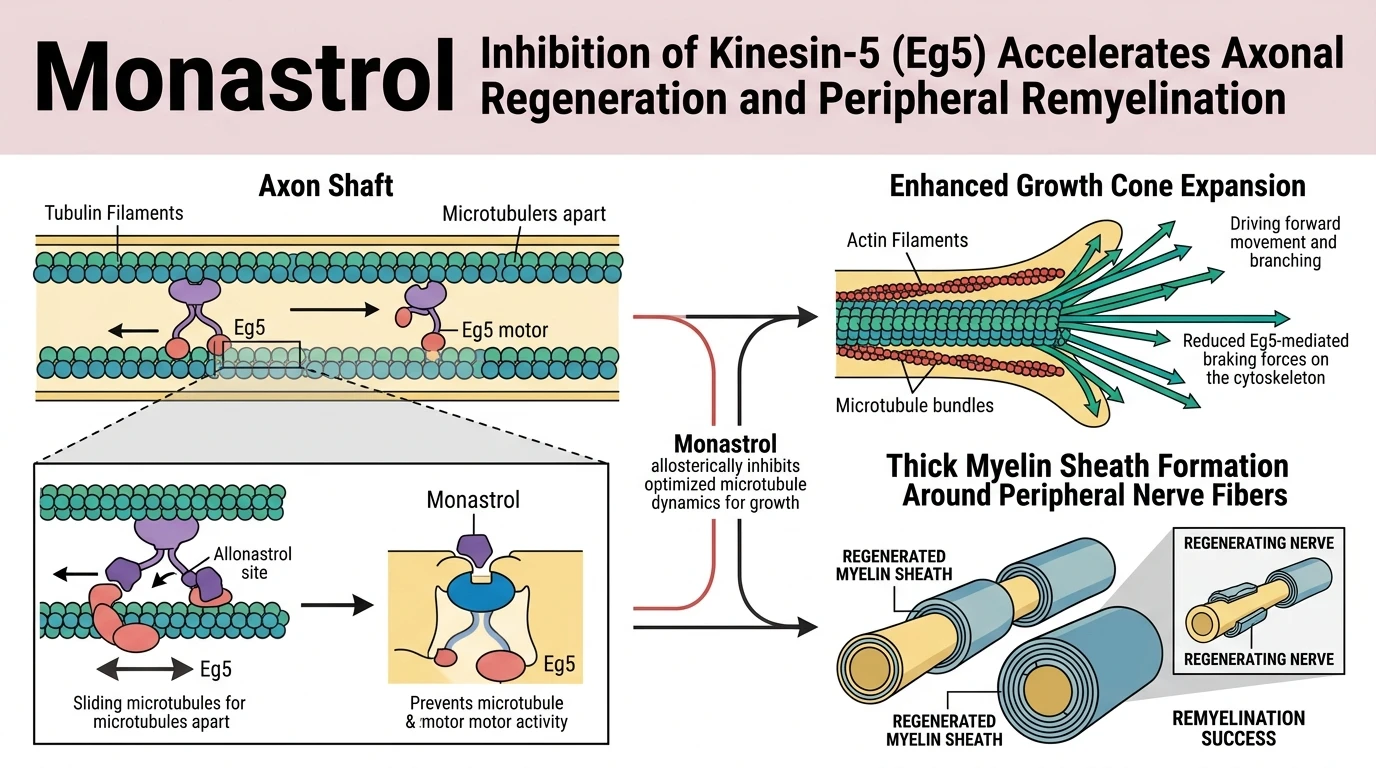
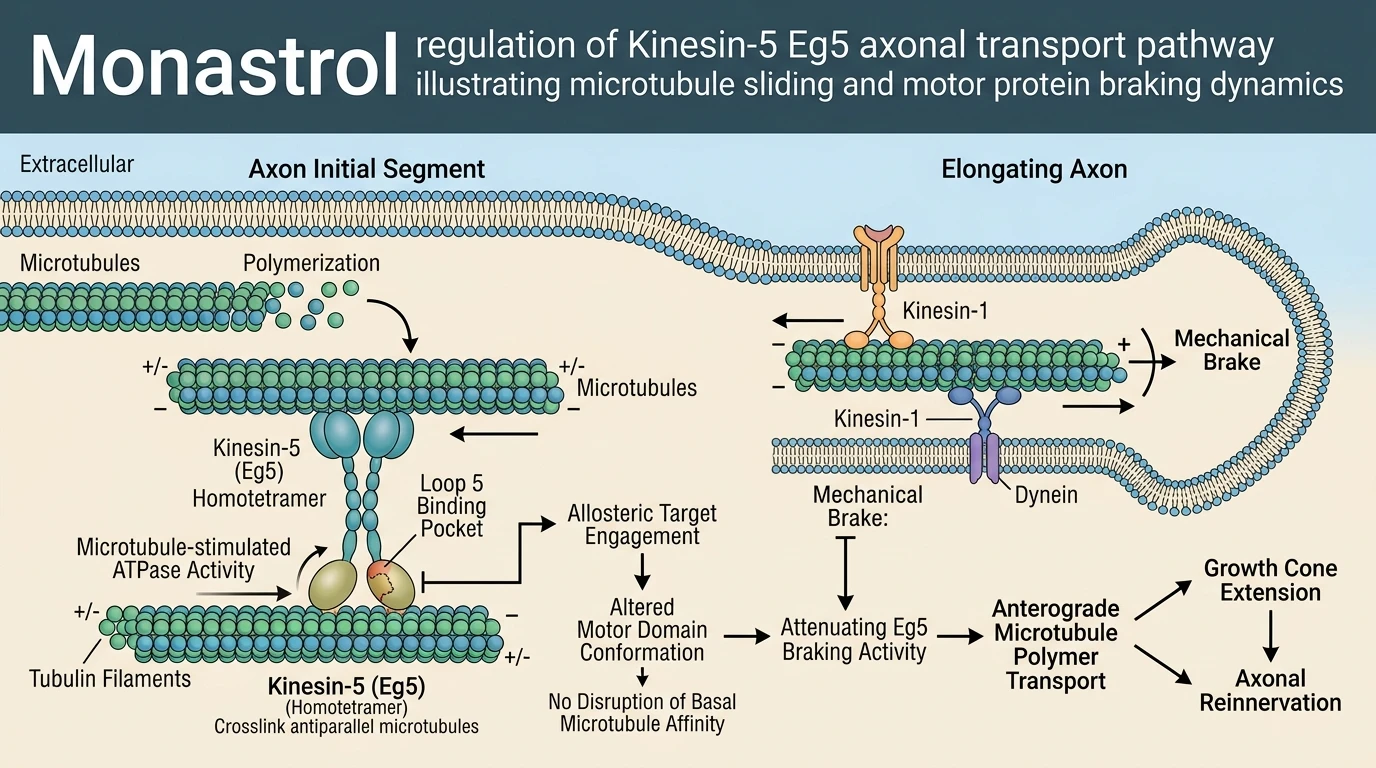
Kinesin-5, designated as Eg5 or KIF11, functions as a homotetrameric motor protein responsible for crosslinking and sliding antiparallel microtubules. While its mitotic function in spindle bipolarity is well characterized, Eg5 performs a distinct mechanical role in post-mitotic neurons. Within developing and regenerating axons, Eg5 acts as a selective molecular brake, restricting the forward translocation of microtubule polymers. This mechanical braking force directly counteracts the anterograde forces exerted by kinesin-1 and cytoplasmic dynein. Pharmacological attenuation of Eg5 motor activity offers a strategic approach to relieve mechanical resistance, thereby accelerating growth cone motility and axonal elongation.
Target engagement at Eg5 was evaluated utilizing Monastrol, a cell-permeable dihydropyrimidinthione derivative. Monastrol functions through allosteric inhibition of microtubule-stimulated ATPase activity of Kinesin-5 (Eg5). Rather than competing directly with adenosine triphosphate (ATP) at the catalytic site, the small molecule binds an allosteric pocket formed by Loop L5, helix α2, and helix α3 of the Eg5 motor domain. Structural and biophysical investigations into allosteric kinesin-5 modulation confirm that ligand binding locks the motor head in an inactive state, slowing ADP release while preserving weak microtubule binding. By inhibiting ATP hydrolysis without causing complete microtubule detachment, the compound selectively decreases the mechanical braking force imposed by Eg5 along the axonal shaft.
The neuro-regenerative efficacy of this targeted allosteric approach was evaluated in a rat model of experimental autoimmune neuritis (EAN), an established in vivo representation of inflammatory demyelinating polyneuropathy. Administration of the small-molecule inhibitor was initiated during the post-peak recovery phase of disease progression. Systemic treatment accelerated functional motor recovery in affected animals relative to vehicle-treated controls. Clinical disability scores decreased markedly in treated cohorts, demonstrating accelerated functional restoration. Electrophysiological recordings revealed that motor nerve conduction velocity recovered to near-baseline levels, indicating effective restoration of saltatory impulse propagation along injured peripheral nerve trunks.
Histological and ultrastructural analyses of sciatic nerve tissue provided structural correlation for the observed functional recovery. Morphometric evaluation demonstrated enhanced remyelination, characterized by thicker myelin sheaths and significantly lowered g-ratios across peripheral nerve fibers. Teased fiber preparations revealed decreased segmental demyelination and preserved nodal architecture. Concurrently, quantitative immunohistochemistry showed reduced endoneurial T-cell infiltration and decreased macrophage density within peripheral nerve lesions, reflecting an attenuated inflammatory milieu. Neuromuscular junction (NMJ) analysis demonstrated enhanced motor endplate reinnervation, with treated animals exhibiting higher proportions of fully occupied postsynaptic acetylcholine receptor clusters relative to controls.
Complementary functional experiments were performed in human induced pluripotent stem cell (hiPSC)-derived motor neurons. In secondary motor neuron cultures, small-molecule Eg5 inhibition induced a pronounced, dose-dependent enhancement of primary neurite outgrowth. Morphological profiling confirmed that accelerated elongation occurred specifically along primary axon trunks rather than through increased secondary branching or collateral sprouting. Furthermore, the compound demonstrated no myelosuppressive or cytotoxic effects across active concentration ranges. Attenuating Eg5 mechanical resistance selectively accelerates anterograde microtubule polymer sliding into the growth cone, establishing favorable biomechanical conditions for axon extension and neuromuscular reinnervation.
Pharmacological Profiling and Neuro-Regenerative Efficacy in Experimental Neuritis
Copy code to add this image to your page
Monastrol acts as a selective, cell-permeable allosteric inhibitor of Kinesin-5 (Eg5), binding to the Loop 5 pocket of the motor domain. This engagement inhibits microtubule-stimulated ATPase activity and slows ADP release, trapping Eg5 in a low-affinity, force-inactive state. In post-mitotic neurons, inhibiting Eg5 relieves its mechanical braking effect on axonal transport. This shift in force generation permits rapid anterograde microtubule polymer translocation, accelerating primary axon elongation, promoting remyelination, restoring motor nerve conduction velocity, and enhancing neuromuscular junction reinnervation without inducing branching or cytotoxic side effects.
Motor Nerve Conduction Recovery in Experimental Autoimmune Neuritis
Therapeutic administration commenced during the disease recovery phase. Monastrol accelerated motor nerve conduction velocity toward baseline levels in EAN rats. Electrophysiological recovery directly correlated with reduced clinical disability scores. Quantitative histomorphometry revealed marked myelin sheath thickening—an effect corroborated by decreased g-ratios across peripheral nerve trunks (p < 0.01). Ultrastructural imaging confirmed compact myelin lamellae preservation. Sciatic nerve analysis demonstrated reduced endoneurial T-cell infiltration; consequently, local neuroinflammation subsided. Neuromuscular junction occupancy assays confirmed restored postsynaptic endplate reinnervation.
Direct Axonal Elongation in Human Stem Cell Motor Neurons
In vitro assays utilized human induced pluripotent stem cell (hiPSC)-derived motor neurons. Monastrol promoted primary axon elongation in a dose-dependent manner. Neurite outgrowth accelerated significantly without increasing collateral branch formation. Cellular viability remained intact across tested micromolar concentrations. No myelosuppressive side effects occurred. Microtubule sliding dynamics within the axon shaft shifted toward anterograde transport—relieving Eg5-mediated mechanical braking. Consequently, target engagement at the motor domain sustained rapid axonal regrowth.